

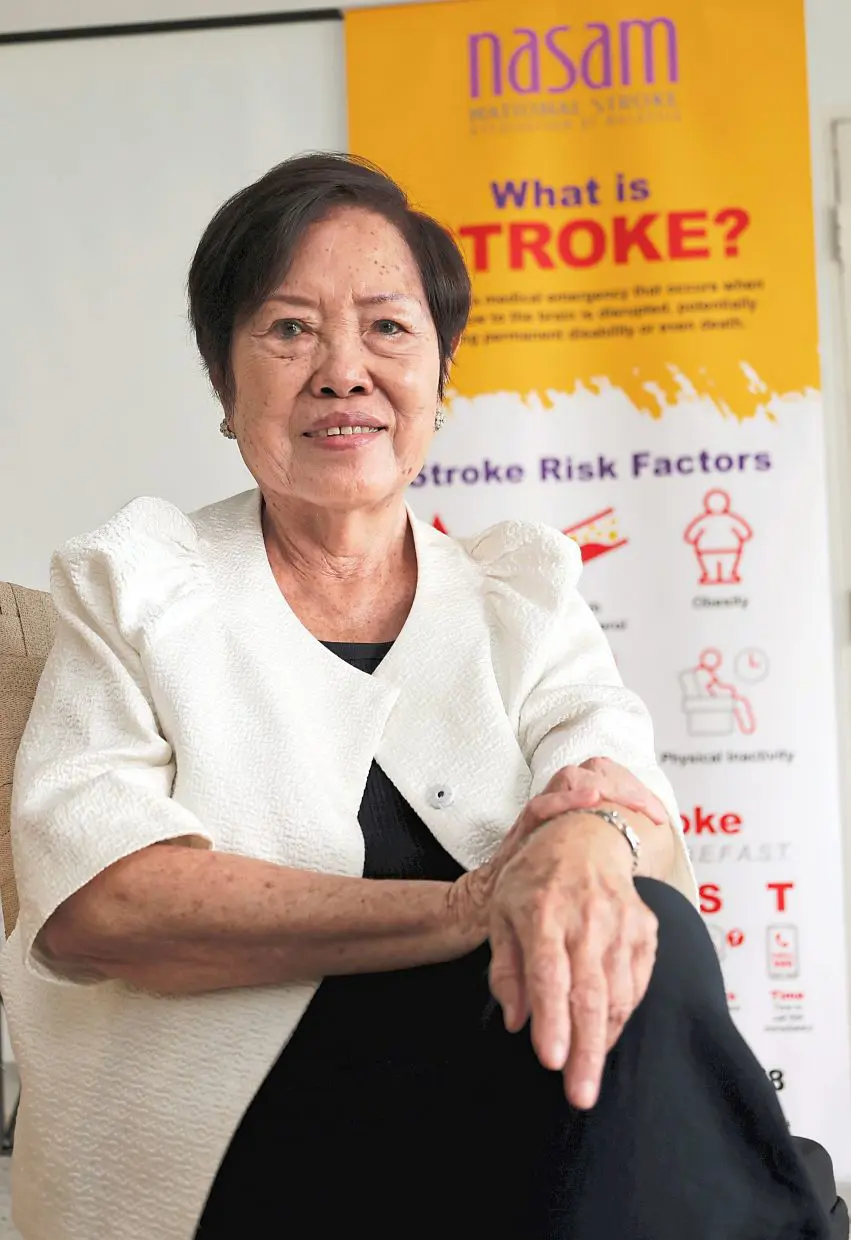
Nearly four decades ago, Janet Yeo woke up and got ready for work as usual.
At 44, she was running two advertising businesses.
“I woke up one morning and then I had an evolving stroke.
“One of my hands couldn’t take commands.
“But at that moment, I could still walk and talk,” she shares.
Unaware that she was having a stroke, Yeo continued with her plans for the day, including an interview and a visit to the hairdresser before returning to her office.
“I didn’t realise that I was having a stroke because I didn’t know the signs and symptoms of a stroke,” she says.
But as the day progressed, her condition worsened.
Her right hand became immobile, and she eventually sought medical attention at a private hospital in Petaling Jaya, Selangor.
ALSO READ: Rush the stroke victim to the hospital, not the clinic!
There, doctors told her she had suffered an ischaemic stroke.
This type of stroke occurs when a blood clot blocks blood flow to part of the brain.
Yeo spent the next month and a half in the hospital, eventually becoming completely paralysed on her right side and losing the ability to speak normally.
The will to recover
During that time, she fell into a deep depression.
“When I was in the hospital, I wanted to die; I was very depressed,” Yeo recalls.
ALSO READ: Watch out for depression after a stroke
Prayer, along with her family, gave her a reason to keep going.
“I decided that I want to live because I have my children and my parents,” she shares.
Paralysed on one side, Yeo struggled with everyday tasks.
She could not read the newspaper nor speak normally, while her affected leg felt so heavy that she had to drag it along.
“At one point, I felt like chopping off this leg because it was so heavy,” she says, adding that it was also painful.
A visit from her staff gave her another reason to keep going.
They came to the hospital and whispered: “Boss, you come back to work because we are like orphans without you.”
She broke down in tears.
“That was the motivation I got from my office, from my staff – that I have to get well.”
The experience taught Yeo that stroke survivors need more than medical treatment.
“They need people to inspire, motivate and show them there is hope,” she says.
ALSO READ: This doctor helped patients recover from stroke, then had one himself
Seeking treatment abroad
In 1989, stroke rehabilitation in Malaysia was still relatively unfamiliar.
There was little information available to stroke survivors, and Yeo knew little about the condition herself.
“That year, there was no literature on stroke,” she says.
“There was no awareness of stroke – I didn’t know anything about stroke.”
Determined to learn more, she travelled to Singapore, where Mount Elizabeth Hospital had just established a stroke-specific rehabilitation unit.
What she saw there changed her understanding of stroke rehabilitation.
Rather than focusing solely on physical therapy, the programme taught stroke survivors how to manage everyday activities and regain their independence.
“They show you how to go to the bathroom.
“They teach you how to use two hands to brush your teeth,” she recalls.
Even mealtimes became part of rehabilitation, with simple adaptations such as wrapping a sponge around a spoon handle to make it easier to grip.
Yeo also learnt how early rehabilitation could help prevent complications such as foot drop.
At the hospital, staff would prop up the affected foot with a pillow.
“If the hospital doesn’t do that for you on the first day, you’ll have a drop foot, which I have,” she says.
Today, Yeo cannot lift her affected foot and has to wear a brace to help raise it.
Her rehabilitation journey continued beyond Singapore.
She spent another two months undergoing rehabilitation in the United States before travelling to Beijing to explore traditional Chinese medicine.
Despite still having difficulty speaking and walking, Yeo returned to work about a year after her stroke.
She went on to build four more businesses, while raising two children and caring for her mother, who had cancer.
“I lived my life,” she says.
But she knew she had been fortunate.
Her company provided health coverage, while insurance helped cover her rehabilitation.
She had access to physiotherapy, acupuncture, gym training and rehabilitation overseas – opportunities many stroke survivors do not have.
“Then I thought to myself, for someone without this access, how do they survive from a stroke?” she says.
That question became a mission.
ALSO READ: Stroke: Timing and rehabilitation critical to regain lost function
Treating the person
The idea of starting her own stroke support group was first voiced in a newspaper article.
A year after Yeo’s stroke, a journalist who had initially interviewed her contacted her again to see how far she had progressed.
That was when she expressed her desire to start a stroke support group.
A few years later, she began bringing stroke teams and survivors together at her office.
As the group grew, survivors asked her to provide physiotherapy.
The first rehabilitation space was not a hospital or a clinic; it was Yeo’s garage.
“We would take all the cars out and have the physio,” she recalls.
She hired a Malaysian physiotherapist, and the initiative operated from her office and home for four years.
It later moved next door, when her sister-in-law bought a house that was custom-built as a centre for the fledging organisation now officially registered as the National Stroke Association of Malaysia (Nasam).
It has now been operating there for 30 years.
But Yeo wanted Nasam to offer more than conventional rehabilitation.
She developed what she called a “holistic programme”, focusing not only on physical recovery, but also on the emotional and social needs of stroke survivors.
“If you go to a hospital, they treat you just like an arm and a leg.
“One hour, finish, bye-bye. See you next week,” she says.
“But here, we look at it from head to toe, because you are still the same person.
“You are still a mother, a father. You still have children. You’re still holistic.”
For Yeo, stroke recovery was also a mental journey.
She says survivors can experience shock and denial before potentially falling into depression.
Without adequate support, some survivors can become withdrawn or depressed.
“Once they are in depression, it’s very hard to get them out.”
Yeo also saw how financial circumstances could affect access to rehabilitation.
“A lot of poorer people don’t have insurance and can’t get physiotherapy.
“They go into depression and just accept it.”
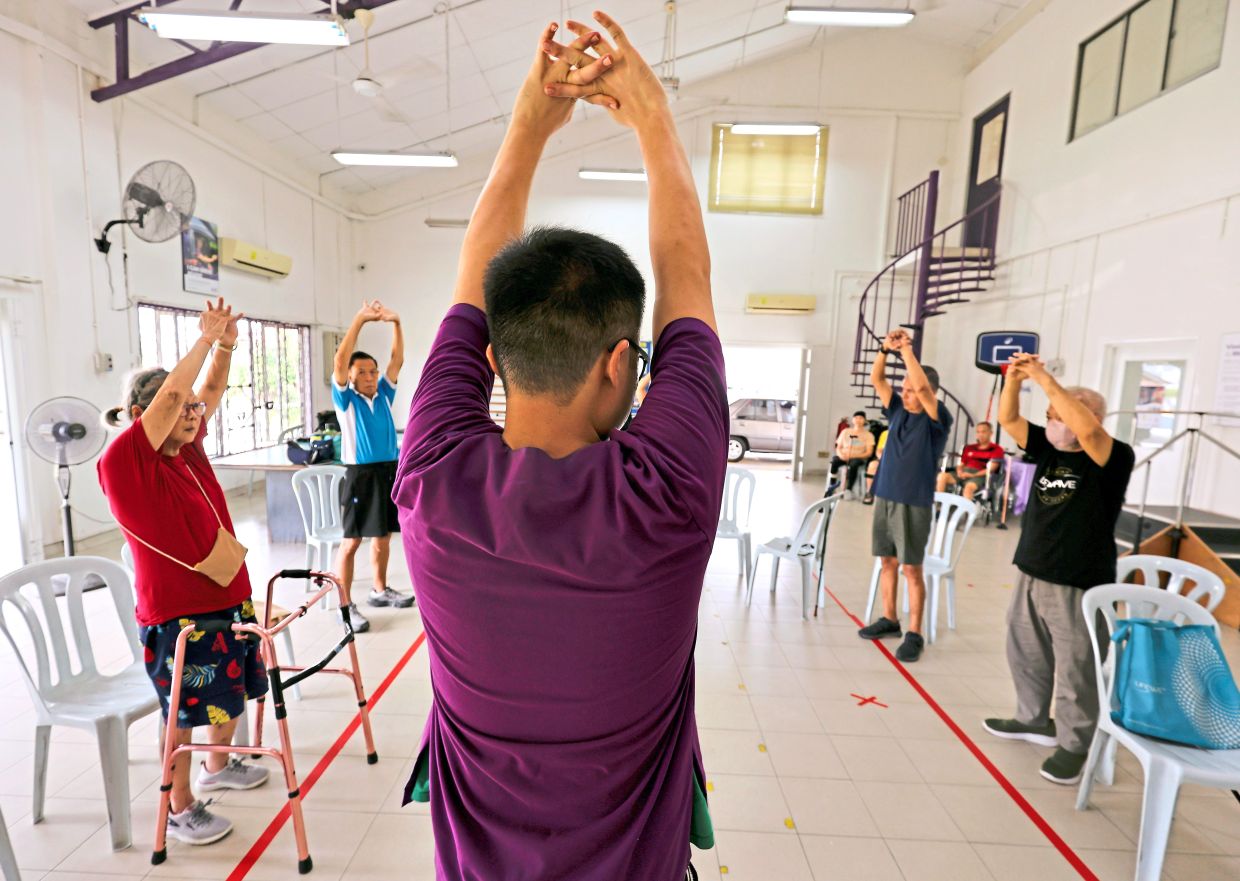
At Nasam, the approach extends beyond therapy, with walks, outings, games and karaoke sessions designed to keep survivors engaged.
“If they don’t come to us, they stay in their room – four walls, TV screen – they give up.”
At the heart of it was a belief she wants every stroke survivor to hold on to: “There is life after stroke.”
ALSO READ: Learning to walk again after a stroke... at 41
Keeping the mission alive
Keeping Nasam going has brought its own challenges
One of Yeo’s biggest struggles has been finding and retaining qualified physiotherapists.
When she started the non-governmental organisation, many physiotherapists in Malaysia were foreign-trained and too expensive for her to hire.
Unable to compete with private sector salaries, Janet travelled to Mumbai, India, to recruit five physiotherapists.
“There were 30 people lined up to be interviewed, so I selected five,” she says.
As more hospitals established stroke rehabilitation units, competition for experienced physiotherapists increased.
“My biggest problem is to get good-quality physios who will stay and work for the small pay that I get, because I cannot compete with hospitals,” she says.
Some physiotherapists eventually leave to provide private home-based treatment, taking some stroke survivors with them.
“So we lose our physios, we lose some of our ‘strokees’, but we have to carry on.
“We’re very lucky that people who stay today, they are with us because they have love and passion,” she says.
For Yeo, the reward is seeing stroke survivors regain their independence.
“Satisfaction is when you see someone come in with a wheelchair or using a stick, but after a few months, they can walk out by themselves.”
Expanding the reach
Nasam was Malaysia’s first stroke-specific organisation, and today, operates six centres in Petaling Jaya, Ampang, Ipoh, Johor Bahru, Kuantan and Kota Kinabalu.
Yeo hopes to expand Nasam’s reach to more areas, as stroke survivors have requested centres closer to their homes.
As the organisation marks its 30th anniversary on Sept 5 (2026), it will bring stroke survivors together for an evening of singing, dancing and celebration.
Yeo, who is scheduled to undergo leg surgery before the anniversary, is looking forward to joining them.
“I want to dance during the anniversary and enjoy with the ‘strokees’,” she says with a laugh.
For more information on how to support Nasam, click here.


No comments:
Post a Comment