src='https://pagead2.googlesyndication.com/pagead/js/adsbygoogle.js?client=ca-pub-2513966551258002'/> Rightways: de-dollarization Infolinks.com, 2618740 , RESELLER

Pages

Share This

Deepseek https://www.deepseek.com/./深度求索 DeepSeek | 深度求索 https://askaichat.app/chat
Showing posts with label de-dollarization. Show all posts

Wednesday, July 29, 2026

The dollar system and global economic imbalances, Crumbling dollar hegemony


Crumbling dollar hegemony.Illustration: Liu Rui/GT

Published: Jul 29, 2026 03:38 PMA narrative has gained traction in recent years that attributes global supply-demand mismatches, trade frictions and growing competitive pressures to expanding industrial supply in emerging markets, particularly what it describes as "China's industrial overcapacity". This argument reverses cause and effect and obscures the deeper issue: the structural flaws of an international monetary system built around the U.S. dollar's dominance.

At the most fundamental macroeconomic level, global imbalances are not primarily an industrial issue, but one rooted in monetary arrangements and balance-of-payments structures. Under the savings-investment identity, a country's current-account balance essentially mirrors the gap between domestic savings and investment. The long-standing global pattern in which deficit countries consume while surplus countries produce is not determined by differences in industrial capacity. It is built into the structure of the dollar-based system.

As the world's dominant reserve and settlement currency, the dollar is subject to the inescapable Triffin dilemma. The U.S. must run persistent current-account deficits to provide the dollar liquidity needed to support international trade, capital flows and foreign-exchange reserves. Much of the dollar-denominated assets accumulated by other countries then flows back into U.S. financial markets, particularly into U.S. Treasury securities. This continually lowers America's overall financing costs and supports persistent fiscal deficits and consumption beyond current means.

This cycle of exporting dollars, importing goods and recycling capital back into the U.S. lies at the heart of global imbalances. It has existed for decades and is not fundamentally linked to the rise of Chinese industry.

Claims that so-called "overcapacity" is disrupting global markets also reveal a clear double standard. The large and persistent trade surpluses generated by Germany's advanced manufacturing sector, Japan's auto industry and U.S. high-tech products are widely viewed as a reflection of international specialization. Yet China's export competitiveness, built on integrated industrial supply chains, cost advantages and technological advances, is characterized as a "market distortion". In reality, the ample supply seen in some Chinese industries stems from persistently weak global demand, shifts in global supply chains and industrialization efforts across countries. It is a consequence of global imbalances, not their cause.

Blaming systemic global imbalances on the industrial capacity of a single country is neither objective nor does it do much to address the problem. Suppressing supply, erecting trade barriers and forcing surplus countries to scale back industrial capacity would only accelerate the fragmentation of global supply chains and further weaken effective global demand.

Addressing the root causes of global economic imbalances requires far-reaching reform of the international financial order.

First, the international monetary system should be further diversified. The global economy should reduce its excessive reliance on a single sovereign currency by expanding the use of the euro, the renminbi and other currencies in cross-border settlement, investment, financing and reserve holdings. Broader use of Special Drawing Rights (SDRs) should also be encouraged to support a more multipolar and balanced monetary system with greater risk diversification.

Second, mechanisms should be established to impose greater discipline on reserve-currency issuers. Global macroeconomic policy coordination should be strengthened to constrain unilateral and aggressive monetary and fiscal policies by major reserve-currency countries and reduce volatility in global capital flows and asset prices resulting from their spillover effects.

Third, the global financial governance architecture should be reformed. Voting shares and governance structures at the International Monetary Fund and the World Bank should be reformed to give emerging markets and developing countries a greater voice. A fairer and more transparent framework for global debt governance and crisis response should also be established.

Fourth, cross-border payment and settlement systems should be diversified. A broader range of cross-border clearing arrangements should be developed to reduce the path dependence of global trade and investment on a single payment system and bolster the resilience of the global financial system.

Global economic imbalances reflect tensions accumulated over a century of globalization and the evolution of the international monetary system. Only by moving beyond the short-sighted approach of blaming supply and shifting responsibility, and by reforming the international financial system toward greater diversity, equality, stability and shared governance, can the world address the underlying pressures behind these imbalances and achieve more balanced and sustainable global economic growth.

Friday, September 5, 2025

How US is eroding its own financial power with a crisis of trust in the dollar


Once hailed as the bedrock of global finance, the US dollar now teeters on the precipice of a crisis of trust. The era of "dollar exceptionalism," where the currency stood invincible, is rapidly crumbling under the weight of Washington's own missteps, which have continuously pushed the world to look for alternatives.

A careful examination of the dollar from the perspective of currency's four basic functions, namely world currency, stores of value, payment and circulation, reveals a startling reality.

From "dollar privilege" to "global enemy"

The US dollar is being pulled into a crisis of trust by its very own mastermind. Bert Flossbach, co-founder and chief investment officer of Germany's largest independent asset management firm, Flossbach von Storch, said: "The US government's chaotic tariff policy has undermined the dollar's safe haven status."

At the heart of the dollar's fall is America's weaponization of its financial system. Since the outbreak of the Ukraine crisis, Western countries froze $300 billion in Russian reserves and expelled Russia financial institutions from the SWIFT system. These drastic measures, intended to crush adversaries, instead triggered a mass exodus from the dollar.

Many countries have accelerated efforts to de-dollarize. Even Saudi Arabia, long the guardian of the oil-dollar nexus, has started accepting other currencies for oil transactions.

In one fell swoop, the very weapon the US used to maintain its financial dominance has turned into its Achilles' heel, splintering the global financial system and hastening the decline of the dollar.

From "safe assets" to "devaluation traps"

The US dollar's stability once rested on two pillars: a robust US economy and the nation's unwavering commitment to its credit. But today, both foundations are crumbling. The US national debt has soared past $36 trillion, with debt-to-GDP ratios hitting nearly 120 percent. The Federal Reserve's response has been to print more money, fueling inflation while simultaneously weakening the dollar.

The consequences are already evident. Countries that once trusted US debt now find themselves trapped in US dollar devaluation, even traditional allies like Japan and Saudi Arabia are offloading their stakes in American debt. Worse yet, the exportation of US inflation to emerging economies, through the "dollar tidal wave" has pushed countries like Argentina and Egypt to the brink of financial bankruptcy, igniting a worldwide movement away from dollar-based reserves.

In short, the American currency has become a ticking time bomb and a "devaluation trap" rather than a safe store of value.

From "everywhere" to "restricted"

The dollar's omnipresence in global trade is retreating. America's control over the SWIFT payment system, once a crucial artery for cross-border transactions, is not as reliable as it once was. Alternatives have emerged: China's CIPS system, Russia's SPFS and the EU's INSTEX are facilitating cross-border transactions without relying on US dollars.

The most significant blow, however, may come from the "petrodollar" system. For decades, oil trading has been anchored in US dollars, cementing its dominance. But countries like Iran, Venezuela, and even the UAE are shifting toward the acceptance of other currencies for oil transactions. This transformation could be the death knell for the dollar's privileged position in the global economy.

On top of this, the rise of central bank digital currencies (CBDCs) is set to further undermine the dollar's supremacy. As countries develop their own digital currencies and enter into cross-border alliances, the dollar's role as the global middleman in trade could be rendered obsolete sooner or later.

America's self-inflicted wounds

While Washington may feel emboldened by its ability to weaponize the financial system, the consequences will ultimately be self-destructive. For one thing, the erosion of trust in US debt will raise borrowing costs for the federal government, exacerbating the already crippling national debt. Secondly, the decline of the dollar as the world's reserve currency will shrink US income from "seigniorage," the revenue generated by printing money. 

For another, as the dollar's dominance erodes, America's geopolitical influence will fade. The loss of its financial leverage means that Washington's ability to impose sanctions or exert pressure on nations will diminish, weakening its role as the global leader.

The message is clear: The world no longer wants a single currency, particularly one that is the symbol of hegemony and is increasingly wielded as a tool of coercion.

The future belongs to a more diversified monetary system: where multiple currencies, including the euro, Chinese yuan, and potentially even gold or digital currencies, will all play a larger role. This shift may be uncomfortable for America, but it is in line with the trend of history.

The dollar's downfall should be a wake-up call for the US. If Washington continues down its current path, it risks turning itself into an isolated financial island, cut off from the very system it once cultivated and ruled.

The time has come for America to take a more collaborative, less confrontational approach, or risk witnessing its global influence slip away.

The author is a commentator on international affairs, writing regularly for Xinhua News, Global Times, China Daily, CGTN etc. opinion@globaltimes.com.cn 

Rrlated posts:

Sunday, September 8, 2024

Bretton Woods should heed the cries for fair play or go, how China can help reshape the global financial system

 Is Bretton Woods fit for the 21st century?


America is financed by the rest of the world because of the hegemomic of the US dollar.

The world's largest economy has moved from a giver of global public goods to a taker of global resources.


Probably the best way to increase global funding is to raise the capital of the global multilateral development banks like the World Bank, Asia Development Bank, etc.

In July 1944, delegates from 44 countries gathered in a UN-sponsored conference in Bretton Woods, New Hampshire to decide on a post-World War II monetary and financial order. 

In the closing speech of the gathering, then US Treasury secretary Henry Morgenthau concluded that the conference had succeeded in addressing the twin “economic evils – the competitive currency devaluation and destructive impediments to trade” that led to the war.

To prevent competitive devaluation, the Bretton Woods conference established the fixed but adjustable exchange rate system, which was based on the US dollar linked to gold and capital controls, securing funding from a newly created World Bank and the International Monetary Fund (IMF). 

The global free trade mechanism was negotiated first through the General Agreement on Tariffs and Trade, which decades later became the World Trade Organization.

The Bretton Woods negotiations were led by the US chief delegate Harry Dexter White and the eminent British economist John Maynard Keynes. Keynes argued unsuccessfully for the creation of an new international currency called the bancor, whereas the United States preferred to use its own currency.


In 1944, the US had the largest share of world GDP and was a major creditor to economies suffering from the destruction of war. It is no surprise that the Bretton Woods order was largely US-led and designed.


This Bretton Woods structure lasted until 1971, when rising US fiscal and trade deficits led US President Richard Nixon to delink the US dollar from gold at the fixed price of US$35 to one ounce of gold. 

After flexible exchange rates became the global norm, the US continued to be financed by the rest of the world because of the hegemonic position of the US dollar. It was protected by the might of the US military and its status as the strongest economy, including being the consumer of last resort.

Eighty years later, the US share of world GDP has been pared down to 26 per cent by current exchange rates but the US dollar remains as mighty as ever.

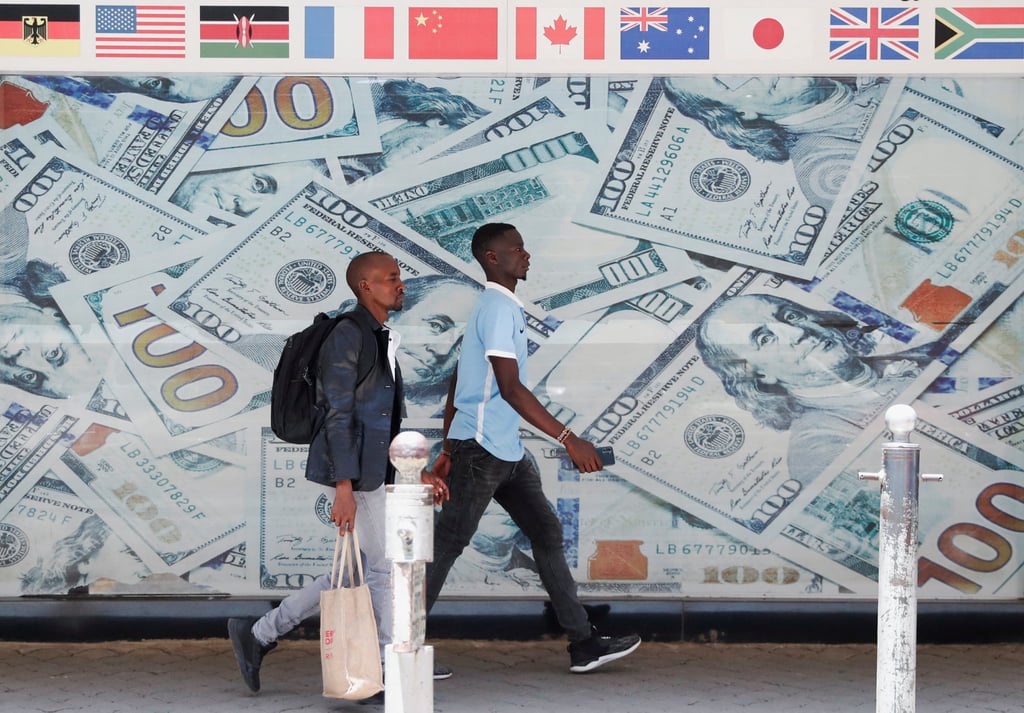
People walk past an image of US dollar bills outside a currency exchange bureau in downtown Nairobi, Kenya, on February 16. Photo: Reuters

Unfortunately, having the US dollar act as the global reserve currency is both a blessing and curse. The US is able to fund its fiscal and trade deficits easily because the rest of the world prefers to hold the US dollar.

But running protracted deficits means that the US net liability to the rest of the world is now US$21 trillion, or about 20 per cent of world GDP, with a gross sovereign debt of US$35 trillion, or roughly one third of world GDP. Fiscal debt cost is rising as interest expenses will rise from 3.4 per cent of GDP in financial year 2025 to 4.1 per cent by 2034.

The irony is that the world’s largest debtor absorbs more of the world’s natural and financial capital that encourages global consumption to drive growth. Since increased levels of consumption ultimately generates more carbon emissions, the current model is neither ecologically nor financially sustainable.

To address these global imbalances, the United Nations has suggested that a “just transition” requires US$2.4 trillion annually to fund clean energy and climate resilience. Where is this money going to come from?


What is climate finance, and why is it crucial to the global energy transition?

This is both a flow and a stock problem. The annual shortfall, or flow, can either be funded from an increase in taxation or a cut in spending. The stock issue is whether there is enough wealth to be taxed or used to fund the needed climate action.
There is growing momentum behind an initiative proposed by French economist Gabriel Zucman, in which a minimum wealth tax of 2 per cent would raise US$200-US$250 billion per year globally from 3,000 billionaires who currently pay little to no tax. Current evidence suggests ultra-high-net worth individuals have an observed pre-tax rate of return to wealth of 7.5 per cent on average per year during the last four decades, while the current effective tax rate is equivalent to roughly 0.3 per cent of their wealth.

Alternatively, the Austrian Institute for Economic Research thinks that a global financial transactions tax of 0.1 per cent could yield between US$238 billion and US$419 billion per year. Needless to say, the rich who control the electoral process in countries across the world will not allow such tax increases.


There are two big-ticket items in global fiscal spending which could be cut. The largest is subsidies on fossil fuels, which were US$7 trillion or 7.1 per cent of global GDP in 2022. On top of that, global military expenditure was US$2.4 trillion in 2023.

Perhaps the best way to increase global funding is to raise the capital of the global multilateral development banks such as the World Bank and Asian Development Bank. If the countries which control the special drawing rights of the IMF can apply their US$650 billion in 2021 to increase the bank’s capital by eight times the leverage, these multilateral development banks can increase their lending by about US$5 trillion.


However, doing so would require these countries to agree that this is a priority, which could be unlikely given the current global atmosphere leaning towards protectionism and isolationism.


In short, the 21st century requires multilateral cooperation in dealing with mutual existential challenges involving climate warming, social imbalances and serious polarisation. If the Bretton Woods framework does not serve the Global South because the established powers are unwilling to reform it, do not be surprised if a new set of institutions rise to replace it.

Andrew Sheng
Andrew Sheng is a former central banker and financial regulator, currently distinguished fellow at the Asia Global Institute, University of Hong Kong. He writes widely on Asian perspectives on

Source link 

Open questions | French economist Marc Uzan on how China can help reshape the global financial system

With the US-led financial consensus at a crossroads, economist Marc Uzan says China has role to play in systemic reform

French economist Marc Uzan is executive director and founder of the Reinventing Bretton Woods Committee, a non-profit organisation established in 1994 to address issues related to the world’s financial architecture. He has been working closely with central banks and finance ministries around the world, as well as international organisations such as the International Monetary Fund and the Group of 20, to bring stakeholders together to attempt to fix the system.

In this latest interview in the Open Questions series, Uzan reflects on the decades of change since the paradigmatic Bretton Woods conference in 1944, and the role China and other emerging economies will play in the global financial system during an era of heightened unilateralism and confrontation. This interview first appeared in SCMP Plus. For other interviews in the Open Questions series, click here.
As suggested by the name of your organisation, the Reinventing Bretton Woods Committee, why did you think that the Bretton Woods system should be restructured back in 1994? Can it be?

This question brought a multitude of thoughts about the objectives of the 44 nations whose representatives gathered at Bretton Woods, New Hampshire, in the summer of 1944 to establish a new economic order.

The world has changed considerably since then. Instead of a system of fixed exchange rates among major currencies, we now have a mixed system with major floating currency areas but fixed rates among smaller countries. At that time, we had capital controls, and now we are a global financial market. And from a small group of 44 countries that became the founding members of the International Monetary Fund (IMF) and Worl 

U.S. debt just hit $35 trillion. Is it putting the global economy at 

risk ...

This nation’s gross cumulative debt has hit $35 trillion — a number so large, the International Monetary Fund warns that it’s putting the entire global economy at risk. 
https://www.marketplace.org/2024/08/13/u-s-debt-just-hit-35-trillion-is-it-putting-the-global-economy-at-risk/
The National Debt is now more than $35 trillion. What does that mean?