

PETALING JAYA: “Be careful.” These are caring words often told to older persons to watch their step.
But fall prevention requires more than simply telling the senior citizen to “be careful”, said Prof Dr Tan Maw Pin, a professor in geriatric medicine at Universiti Malaya Medical Centre.
But fall prevention requires more than simply telling the senior citizen to “beMalaysia, she said, has yet to implement a coordinated national falls prevention strategy despite the National Health and Morbidity Survey 2025 report stating that about 15% of Malaysians aged 60 and above fall at least once a year.
“Getting the statistics is important but it must lead to policy, investment, implementation and evaluation,” she said.
According to the World Health Organization, falls are the second leading cause of unintentional injury deaths worldwide, with adults older than 60 suffering the highest number of fatal falls.
ASLO READ: Easing big fears of small falls with home modifications
Dr Tan said a fall should never be dismissed as a normal part of ageing.
ASLO READ: Easing big fears of small falls with home modifications
Dr Tan said a fall should never be dismissed as a normal part of ageing.
“The likelihood of falling – and of sustaining a serious injury – rises with age, frailty, muscle weakness, osteoporosis and chronic illness.
“A fall may cause a hip fracture, head injury, bleeding or other fractures,” she added.
Dr Tan cautioned that its consequences frequently extend beyond the immediate injury.
“An older person may become afraid of falling again, reduce their activity, lose muscle strength and become increasingly dependent.
“Some never regain their previous mobility or independence,” she explained.
A first fall should be regarded as a warning sign warranting assessment, particularly if it is unexplained or results in injury, Dr Tan noted.
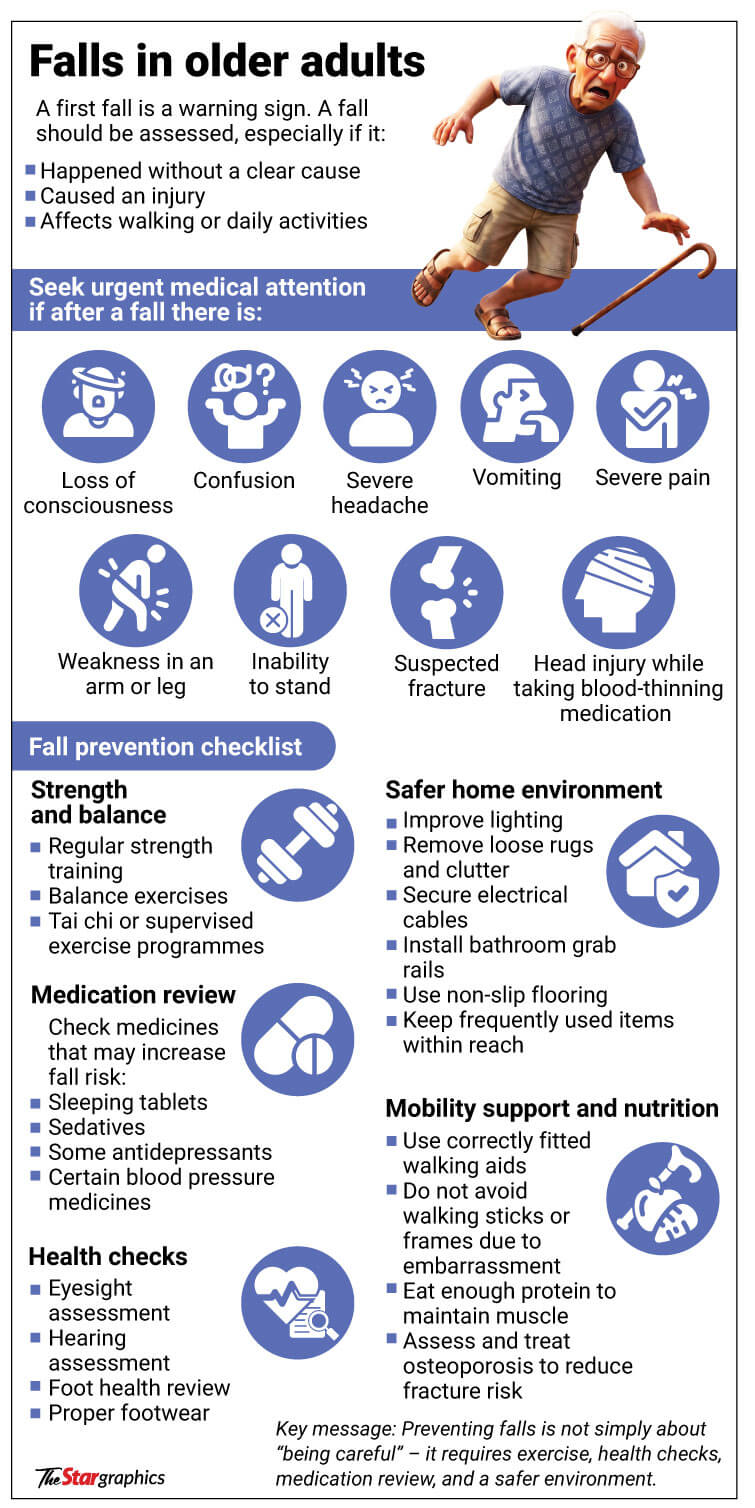
“Anyone who develops loss of consciousness, confusion, severe headache, vomiting, weakness of an arm or leg, inability to stand, severe pain or a suspected fracture after a fall should receive urgent medical attention.
“People taking blood-thinning medication should also be assessed promptly following a head injury, even if they initially appear well,” she added.
Dr Tan also said medication such as sedatives, some antidepressants and certain blood-pressure medicines might cause drowsiness or a sudden drop in blood pressure.
“Eyesight, hearing, foot problems and footwear should also be assessed.”
Dehydration and medication side effects might also precipitate a fall, she said.
“Some falls result from heart rhythm abnormalities or fainting and should not automatically be blamed on ageing or clumsiness,” Dr Tan added.
ASLO READ: Never too late for stronger muscles and safer steps
“Mental and neurological factors are equally relevant. Dementia may affect judgement, attention and awareness of hazards.”
She said older folk should exercise regularly to improve muscle strength and balance, adding that this could include supervised strength training, balance exercises or tai chi.
“At home, carers can improve lighting, remove loose rugs and clutter, secure electrical cables, install grab rails in bathrooms, provide non-slip flooring and ensure frequently needed items are within easy reach,” Dr Tan advised.
“Walking aids must be correctly fitted and used consistently. Older people should not feel embarrassed about using a walking stick or frame.”
While Malaysia has made progress in public spaces, Dr Tan said it is not yet consistently age-friendly.
“Newer facilities may provide ramps, lifts and accessible toilets, but the routes leading to them may still contain broken or uneven pavements, poorly placed drains, slippery surfaces, inadequate lighting or missing handrails,” she said.
Association for Residential Aged Care Operators of Malaysia president Delren Terrence Douglas said many towns and cities are still not designed with the needs of senior citizens in mind, making everyday activities such as walking, shopping or visiting public parks unnecessarily difficult.
He said in some malls and parks, elderly people often have to keep walking despite feeling tired because there are few places to sit and rest.
“A shortage of benches, handrails and accessible ramps leaves many seniors struggling to complete even short journeys,” he added.

