Tang (left) showing Mat Suaid (second right) and agriculture department staff the durians at his Gertak Sanggul orchard. The opened fruits are Black Thorn (right) and Musang King. — Photos: CHAN BOON KAI/The Star
BALIK Pulau durian farmers take immense pride in the varieties grown for generations in Penang.
In order to avoid disappointment and paying a premium price for sub-par fruit, Southwest District Agriculture Department officer Mat Suaid Sapiyin advised durian lovers to learn to recognise the physical traits rather than trusting a seller’s claims.
“Take the much sought-after Black Thorn (Or Chi) for instance.“The premium variety is typically round and weighs between 1.5kg and 2.5kg.
“It has a prominent dot at the base resembling a thorn,” he said.
Mat Suaid encouraged consumers to familiarise themselves with the main clones from the area and verify the orchard’s location.
The Black Thorn (right) has a prominent dot at the base resembling a thorn, while Musang King (left) has a flat crown and vertical seams running down to a distinct five-point star at the base.
“Do not to be swayed by irresponsible traders or middlemen when buying the fruit.
“Choose reputable or registered farmers, check the stem, aroma and ripeness of the fruit, and ask for documentation, especially for the Geographical Indication (GI) of premium varieties.”
Mat Suaid said Penang was still in the process of implementing Mi-Trace, a QR code system developed with Mimos Bhd to help combat fraud and misrepresentation.
Farmers are also registered with the Intellectual Property Corporation of Malaysia (MyIPO) and district agriculture office and have acquired Malaysian Good Agricultural Practices (myGAP) certification to strengthen source verification of their fruits, he added.
Orchard owner Tang Boon Ley, 60, said there was also a need for processing platforms or collection centres with blast freezers, cold storage, and downstream processing facilities.
He said it could be a long-term solution for surplus durian.
“Now may be the best time for people to eat premium durian at a lower price, but eventually something must be done.”
He said such infrastructure, coupled with cooperative models, would help stabilise prices, reduce wastage and allow growers to tap into value-added products such as durian paste, ice-cream and confectionery.
Musang King now RM20-30/kg
Going easy: Tang (left) showing Fahmirudin (second from left) and other officers a particular type of durian at his orchard in Getak Sanggul, Penang. In the foreground are Musang King (left) and Or Chi durians. — CHAN BOON KAI/The Star
GEORGE TOWN: The prices have dropped but many consumers are not biting.
Musang King durian is now selling at lower prices due to oversupply but traders are not seeing roaring sales yet.
Durian orchard owner Tang Boon Ley believes this is partly due to families prioritising school expenses as the new term begins on Monday.
“Durians are not a priority for them at the moment,” he said in an interview.
Tang said Musang King is now priced between RM20 and RM30 per kg, a sharp drop from RM60 to RM80 per kg during the previous durian season from May to August.
Furthermore, he said weaker consumer spending was also due to the fact that the fruit is being sold outside the main durian season.
“This is considered a ‘bonus’ season,” he said.
Tang said the growing number of Musang King orchard owners had led to an oversupply, further driving prices down. At the same time, newer durian varieties have also entered the market, intensifying competition, he said.
“For durian lovers, this is the best time to enjoy affordable Musang King. This is expected to last until Chinese New Year.
“Prices are likely to return to normal when the new durian season begins in May,” he said.
Once the undisputed favourite among durian fans, Musang King now faces stiff competition from other varieties such as Or Chi (Black Thorn) and Tupai King.
Penang Agriculture Department assistant agricultural officer Fahmirudin Zainol Abidin said wholesale prices for Musang King have dropped significantly, as processing facilities struggle to cope with the surplus.
He said the price decline was driven by simultaneous harvesting in Penang, Perak, Pahang and Johor, with overall production estimated to have tripled.
“This is not a demand issue but a capacity problem. Excess supply has pushed prices down,” he said.
Penang has two durian seasons annually, with the harvest typically peaking in June and July.
In identifying genuine durians from Balik Pulau, particularly Ang Hae (Red Prawn), Fahmirudin said the variety can be determined through subtle physical traits.
“Local Ang Hae typically has a slightly greyish husk and a distinctive fruit shape that differs from similarly named varieties found in Perak, Pahang or Johor.
“Or Chi, on the other hand, is recognised by its rounder shape, widely spaced thorns and a pronounced star-shaped base.
“These are the features growers use to distinguish it from Musang King,” he said.
The class of drugs known as GLP-1 receptor agonists have become renowned for their effects in helping weight loss.
MALAYSIA is the most obese and overweight nation in Asean.
Overweight
adults form 32.6% of the population, while obese adults form another
21.8%, adding up to 54.4% of the population.
Not only that, about 29.8% of children are obese or overweight.
In addition, about 21% of Malaysians are diabetic, of which 80% are obese or overweight.
The Health Ministry (MOH) is introducing glucagon-like peptide 1 (GLP-1) medicines for “vulnerable groups” this year.
Who the vulnerable groups are is unclear.
However, it behoves everyone to ensure that patient safety is not compromised by the use of GLP-1 medicines.
How they work
GLP-1
medicines are receptor agonists that mimic the GLP-1 hormone that is
naturally released in the gastrointestinal tract in response to
eating.
When a person eats, the digestive system breaks down carbohydrates into simple sugars that enter the bloodstream.
GLP-1 stimulates the release of insulin from the pancreas.
Insulin,
a pancreatic hormone, helps get glucose out of the bloodstream
into the body’s cells, where it is used for nourishment and energy.
In
diabetes, the body’s cells are resistant to insulin, do not produce
sufficient insulin, or both. GLP-I medicines stimulate the
pancreas to release insulin and reduce the release of glucagon.
Both insulin and glucagon control the blood glucose levels in humans, including type II diabetics.
GLP-1 medicines also act on the brain to reduce hunger and delay emptying of the stomach.
These drugs are used in the management of type II diabetes, and in some instances, obesity in non-diabetics.
They reduce food cravings, increase fullness (satiety), slow digestion and can help control blood glucose.
GLP-1
medicines were licensed for diabetes management in Malaysia in
2007, and was approved for obesity management in 2019.
As of 2025, there are more than 30 GLP-1 medicines registered.
There are different types of GLP-1 medicines.
Some are injections and others
are
tablets. Some are licensed for diabetes, and others are licensed for
weight-loss management, or to treat the overweight with
weight-related health problems.
Side effects
Like all medicines, GLP-1 agonists have side effects.
The
common ones are gastrointestinal, i.e. nausea, vomiting and
diarrhoea, which are usually mild to moderate, and of short
duration.
Sometimes, these side effects can be serious, leading to severe dehydration that requires hospitalisation.
A serious, but uncommon, side effect is pancreatitis.
Anyone on GLP-1 medicine with severe abdominal pain that radiates to the back should seek immediate medical attention.
Other
serious, but uncommon, side effects include: > Gastroparesis –
where movement of food out of the stomach is slowed or stopped >
Bowel obstruction – a blockage that keeps food from passing through
the intestines > Gallstone attacks, and
> Bile duct blockage.
Rapid
weight loss can cause facial changes that include a hollowed look,
wrinkles, sunken eyes, sagging jowls around the jaws and neck, and
changes in the size of the lips, cheek and chin.
This is commonly called the “Ozempic” face, after the brand name of one of the more wellknown GLP-1 medications.
If the weight loss is less rapid, the facial changes would not be so obvious.
Significant facial changes can be treated by plastic surgery.
The
sexual side effects of GLP-1 medicines involve both potential
improvements (through weight loss and hormonal optimisation), and
declines in libido or arousal, which is variable across sex and
individual profiles.
A full list of the known side effects is found in the product information of the individual GLP-1 medicine.
A recent review reported that
GLP-1 medicines may have little or no effect on obesity-related cancers, i.e. thyroid, breast, pancreatic or kidney.
They
may also have little or no effect on colorectal, oesophageal, liver,
gallbladder, ovarian or endometrial cancer; multiple myeloma; or
meningioma (low certainty).
The effect on gastric cancer was very uncertain.
Current
data does not support a causal association between GLP-1 medicines
and depression, suicidal ideation and suicide.
Precautions
GLP-1
medicines should not be taken in pregnancy, by those who are trying
to get pregnant or by those who are breastfeeding, because there is
insufficient data on the drugs’ safety in such situations.
In
the case of those trying to get pregnant, the number of months the
GLP-1 medicine should be stopped prior to attempting conception
varies, depending on the individual medicine.
Oral
contraceptive users should use barrier contraception, e.g.
condoms, for four weeks after starting GLP-1 medicines, and for four
weeks after any increase in dose.
The reason is that the GLP-1 medicines may reduce the effectiveness of oral contraceptives in the overweight or obese.
Alternatively,
a non-oral form of contraception, e.g. an intrauterine
contraceptive device (IUCD) or implant, which are not as affected by
GLP-1 medicines, can be used.
Prior to a
surgical procedure, the patient should inform their attending
doctors and nurses if they are taking GLP-1 medicines.
This
is because these drugs slow the emptying of the stomach, thereby
increasing the likelihood of stomach contents entering the
airways and lungs during the surgical procedure while under
general anaesthesia or sedation.
This means that modification of the pre-procedure instruction and anaesthetic technique may be required.
The attending doctor(s) will also advise on the taking of prescribed medicine(s).
Be aware
It is vital to remember that GLP-1 medicines are Group B poisons, i.e. they require a doctor’s prescription.
It is illegal to purchase them over the counter or through unlicensed online sellers.
Self-medication
is potentially dangerous – a message that applies not only to GLP-1
medicines, but also many prescription medicines.
Reports of misuse of GLP-1 medicines for cosmetic weightloss purposes are of concern.
The
global demand for GLP-1 medicines has led to the spread of false and
substandard products, with severe risks to patient safety, economic
impacts and erosion of public trust.
These
counterfeit medicines often contain incorrect dosages, harmful
ingredients or lack the active GLP-1 entirely, leading to
ineffective treatment and potentially life-threatening
complications such as hyper/hypoglycaemia and cardiovascular
(heart) issues.
The economic impacts are
considerable, with substantial costs incurred in managing
complications that include hospitalisation and increased
monitoring efforts.
Guidelines for doctors The framework for GLP-1 use in Malaysia is found in the
Clinical Practice Guidelines for the Management of Obesity.
GLP-1
medicines are recommended for adults with a body mass index (BMI)
more than 30kg/m2 or a BMI more than 27kg/m2 with one weight-related
concurrent illness, e.g. hypertension (high blood pressure), type
II diabetes or dyslipidaemia (abnormal fat levels).
The
World Health Organization (WHO) launched its guideline on the use of
GLP-1 therapies for the treatment of obesity in adults on Dec 1,
2025.
The good practice statements in the guideline are:
>
“Obesity is a chronic complex disease that requires lifelong care
beginning with clinical assessment and early diagnosis.
“Once
diagnosed, individuals should have access to comprehensive
chronic care programmes offering sustained behavioural and
lifestyle interventions.
“When
appropriate, pharmacological, surgical or other therapeutic
options may be used to support effective disease management.
“In parallel, care should address the prevention and treatment of obesity-related complications and comorbidities.”
>
“In adults living with obesity, GLP-1 receptor agonists or GIP/ GLP-1
dual agonists may be used as long-term treatment for obesity.”
>
“People living with obesity should receive context-appropriate
counselling on behavioural and lifestyle changes – including, but
not limited to, physical activity and healthy dietary practices –
as an initial step toward more structured behavioural
interventions.
“For individuals who are
prescribed GLP-1 receptor agonists or GIP/GLP-1 dual agonists,
counselling on behavioural and lifestyle changes should be provided
as a first step to intensive behavioural therapy to amplify and
support optimal health outcomes.
> “In
adults living with obesity who are prescribed GLP-1 receptor agonists
or GIP/GLP-1 dual agonists, intensive behavioural therapy may be
provided as a co-intervention within a comprehensive multimodal
clinical algorithm.”
The jury is out on whether the WHO good practice statements will be implemented in toto or partially in MOH facilities.
Part of a strategy
Recognising
that medicines by themselves would not by themselves address the
global obesity challenge, the WHO recommended a comprehensive
strategy based on:
> “Creating
healthier environments through robust population-level policies to
promote health and prevent obesity. > “Protecting individuals
at high risk of developing obesity and related comorbidities
through targeted screening and structured early interventions. >
“Ensuring access to lifelong person-centred care.”
The
safe use of GLP-1 medicines requires regulated distribution and
prescription by doctors, strong oversight, patient education and
stakeholders’ cooperation to ensure that public health is
protected.
Dr Milton Lum is a past
president of the Federation of Private Medical Practitioners
Associations and the Malaysian Medical Association. For more
information, email starhealth@thestar.com.my. The views expressed do
not represent that of organisations that the writer is associated
with. The information provided is for educational and
communication purposes only, and it should not be construed as
personal medical advice. Information published in this article is
not intended to replace, supplant or augment a consultation with a
health professional regarding the reader’s own medical care. The
Star disclaims all responsibility for any losses, damage to
property or personal injury suffered directly or indirectly from
reliance on such information.
SHAH ALAM: It’s a common wish list for non-Chinese parents who send their children to Chinese schools.
“I want her to learn and converse in Mandarin,” said Megat Azri Hakim Sazali of his daughter Puteri Humaira Rose, seven, who is enrolled at SJK(C) Ladang Regent, Elmina, here.
In fact, he had been preparing her for the past three years by sending her to a Mandarin-medium kindergarten.
“This means that she would not face a ‘culture shock’ when attending school.
“The kindergarten prepared her well. She was given a lot of homework even then!”
Exam review: Fadhlina says the ministry will consider parents’ views on the abolition of UPSR and PT3, as well as Classroom-Based Assessment performance levels, in its review on reinstating the two national exams. — Bernama
Another parent, Mohd Azwan Mohd Noor, said it was important for him that his three daughters – nine-year-old twins and an eight-year-old – could converse in Mandarin.
“China is now a powerful economy in the world. Being able to converse in Mandarin would be an advantage,” he said.
Another important factor is that Chinese schools attract a mix of students from different races, he added.
For Shakilla Khoriri, the chance to educate her daughter in Mandarin was too good to pass up.
She wanted her daughter Nurul Ameena Sofia Muhd Hafizudin, seven, to embrace the discipline practised in Chinese schools.
“Children nowadays are growing up in a different world, one where if we as parents are not careful, they will get ‘lost’,” she said.
First-day nerves: A pupil crying on the first day of school at SJK(C) Ladang Regent, Elmina. — IZZRAFIQ ALIAS/The Star
“I want my daughter to interact and pick up the good habits of the students in Chinese schools.
“At the same time, she would be able to converse in Mandarin with them.”
Shakilla had earlier intended to send her daughter to a private school, which was further away from their home.
“But when I heard that a Chinese school was opening up here, I immediately enrolled (her),” she said.
Another parent, Krishnaveni Janardanan, said it was her husband who suggested that their daughter attend a Chinese school.
She said the ability to speak fluent Mandarin opens up numerous opportunities in today’s working world.
“Lucky for us, the government had opened a Chinese school here in Elmina where I live,” she said.
Happy tummies: Pupils posing as they finish their breakfast during recess at SJK(C) Ladang Regent, Elmina. — IZZRAFIQ ALIAS/The Star
For these children, their first day of school saw them attending Year One classes where the teachers gave out instructions purely in Mandarin.
But they seemed to have no trouble following the classes, as most of them had been learning Mandarin since kindergarten.
Yesterday marked not only the first day of the 2026 school year but also the launch of SJK(C) Ladang Regent, Elmina.
Its board of directors chairman Datuk Dr Azman Ching said there are around 300 students enrolled at the school, which was relocated from Gemencheh, Negri Sembilan.
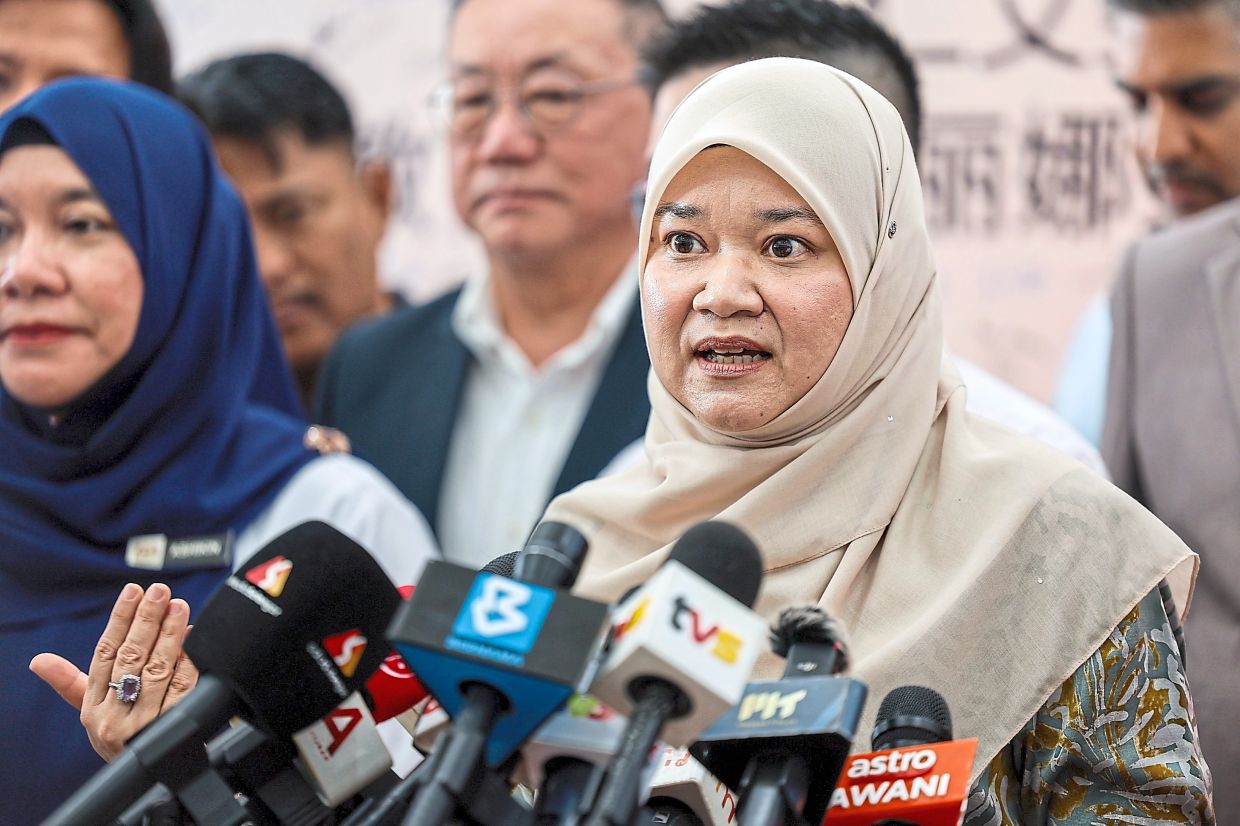
Meanwhile, Education Minister Fadhlina Sidek, who was present at the launch, said all stakeholders will soon be required to sign the Child Protection Policy as a pledge to safeguard children.
“We are not going to compromise on this matter. It is our shared responsibility to ensure our schools are safe and our children are protected,” she said.
The ministry will also be distributing a Safe Schools book to students and parents, she added.
Fadhlina also said the ministry is taking into account all views from parents regarding the abolishment of the Ujian Pentaksiran Sekolah Rendah (UPSR) and Penilaian Tingkatan Tiga (PT3) examinations, as well as the performance levels for the Classroom-Based Assessments, when they begin reviewing the reinstatement of the two national examinations.
“The review will be held this year and we will announce (the results) as soon as possible,” she said.
Last week, the minister said that she had reactivated the National Education Advisory Council to study the need to revive the two examinations.
UPSR was abolished in 2021, followed by PT3 in 2022, and both were replaced with School-Based Assessment.
More than five million students began the 2026 school year nationwide since Sunday.
US Department of Justice federal officers stand guard outside the Metropolitan Detention Center, where ousted Venezuelan President Nicolas Maduro is being held, in the Brooklyn borough of New York City, on January 4, 2026. Venezuela's deposed president Nicolas Maduro is scheduled to appear before a federal judge in New York at noon on January 5, to be formally notified about the charges against him, the court said. Maduro and his wife, Cilia Flores, were seized by US forces during a pre-dawn raid on January 3 in Caracas and brought to New York to face charges of "narcoterrorism" tied to alleged trafficking of tons of cocaine into the United States. - AFP
BEIJING: Chinese Foreign Minister Wang Yi said Beijing cannot accept any country acting as the "world's judge" after the United States captured Venezuela's President Nicolas Maduro.
"We have never believed that any country can act as the world's police, nor do we accept that any nation can claim to be the world's judge," Wang told his Pakistani counterpart Ishaq Dar during a meeting in Beijing on Sunday (Jan 4), referring to "sudden developments in Venezuela" without directly mentioning the US.
"The sovereignty and security of all countries should be fully protected under international law," China's top diplomat added, in his first remarks since images of the 63-year-old Maduro blindfolded and handcuffed on Saturday stunned Venezuelans.
Maduro is in a New York detention centre awaiting a Monday court appearance on drug charges.
Beijing has ambition to become a diplomatic heavyweight, a goal it articulated most clearly after brokering a surprise rapprochement between Saudi Arabia and Iran in 2023, pledging to "play a constructive role in global hotspot issues."
Analysts say Beijing's success in going toe-to-toe with the US in trade negotiations has only reinforced China's confidence.
However, President Donald Trump's assertion that the US will oversee Venezuela's government for the time being poses a stern test to the "all-weather comprehensive strategic partnership" Beijing and Caracas struck in 2023, marking almost 50 years of diplomatic ties.
"It was a big blow to China, we wanted to look like a dependable friend to Venezuela," said a Chinese government official briefed on a meeting between Maduro and China's special representative for Latin American and Caribbean affairs, Qiu Xiaoqi, hours before his capture.
Maduro's son visited China's top-ranking Peking University in 2024, where he enrolled in 2016, they said, adding they were unsure whether he would return despite years of diplomatic engagement with Caracas around his education and ties to China.
The world's second-largest economy has provided Venezuela with an economic lifeline since the US and its allies ramped up sanctions in 2017, purchasing roughly US$1.6 billion worth of goods in 2024, the most recent full-year data available.
Almost half of China's purchases were crude oil, customs data shows, while its state-owned oil giants had invested around US$4.6 billion in Venezuela by 2018, according to data from the American Enterprise Institute think tank, which tracks Chinese overseas corporate investment. - Reuters
Keith’s BYD car dealership in Leeds, England. In the last year, Chinese-made vehicles have doubled their share of new car registrations in Britain. — Owen Richards/The New York Times
ON a recent Monday in Leeds, Dougal Keith drove a Chinese-made BYD Seal Excellence out of his dealership and hit the accelerator.
The car can reach 100kph in 3.8 seconds – a key selling point – and comes with a £48,000 price tag, roughly 20% cheaper than a top-range Tesla Model 3.
Keith, a car salesman for more than 40 years, said customers were sceptical of buying Chinese vehicles when he opened a showroom for BYD in 2023.
Now, he runs six dealerships devoted to the brand.
“Some people think because it’s Chinese it’s made cheaply,” he said. “But then I ask, ‘Where do you think your iphone is assembled?’”
Chinese cars are gaining ground in Britain for a mix of reasons.
There are no steep tariffs on Chinese EVS – unlike in the EU or the US – allowing lower prices. British buyers are also less brand-loyal, with no major domestic mass-market automaker to defend.
Roughly a dozen Chinese brands, including BYD, Chery and Geely, made up 13% of new car registrations in Britain in November, double their share a year ago, according to the Society of Motor Manufacturers and Traders.
“The pace is like nothing the market has ever seen,” said Ian Plummer, chief commercial officer of Autotrader.
BYD and Chery, selling Jaecoo and Omoda models, are gaining market share five or six times faster than Tesla a decade ago or South Korea’s Kia in the 1990s.
Britain’s domestic auto industry has been shrinking, producing about 600,000 cars in 2025, roughly half of the output at the end of the last decade.
Major producers include Nissan, Jaguar Land Rover and Mini.
Meanwhile, China is now the world’s largest car exporter and leads in EV production, exporting to markets from Mexico to South Africa.
Chinese automakers have mastered shifting regulations and consumer demand, particularly for hybrids.
Beijing encourages exports to manage domestic overcapacity, sometimes leading to heavy losses and triggering pushback in Western countries.
The US has imposed 100% tariffs on Chinese EVS, the EU up to 45%, while Britain charges 10% on all imported cars.
About two million new cars are sold in Britain each year.
Since 2019, the number of brands registering sales has nearly doubled to over 70.
No single brand commands loyalty like Volkswagen in Germany or Renault in France, giving newcomers room to grow.
Chinese brands first gained a foothold with SAIC Motor’s acquisition of MG.
Production gradually moved to China, and the UK MG factory closed in 2016.
MG now accounts for over 4% of new registrations – the largest share for a Chinese-owned brand – while BYD holds just over 2%, similar to Tesla.
Keith sold his first car in 1980 at 16 and later expanded his family business.
By the early 2020s, he noticed BYD and,
“Some people think because it’s Chinese it’s made cheaply. But then I ask, ‘Where do you think your iphone is assembled?’”
Dougal Keith
with other independent dealers, secured one of the first UK franchises.
Initially, sales were slow, with only an all-electric model available.
As more models arrived, particularly plug-in hybrids, sales surged.
“Customers are beginning to understand it’s not a budget brand,” said Fozia Siddique, who has worked with BYD since the Leeds showroom opened.
She recently sold a BYD plug-in hybrid SUV to Steve Vine, 55, who drives more than 480km from Leeds to Cornwall and wanted a long-range EV.
Roger Lyons, 60, in Derbyshire, chose a £48,000 BYD Seal Excellence after testing Audi, Hyundai and Porsche models.
“It’s almost as nice to drive as a Porsche, and it’s got more toys than any of the others,” he said, adding that switching to electric would help cut fuel costs.
Encouraged by the success of BYD, Keith opened two more dealerships selling Changan vehicles.
His group, which runs 28 dealerships selling global brands, expects £500mil in sales for 2025, over 50% higher than 2024.
In September, the Leeds BYD showroom outsold all his other local locations.


 The Black Thorn (right) has a prominent dot at the base resembling a thorn, while Musang King (left) has a flat crown and vertical seams running down to a distinct five-point star at the base.