src='https://pagead2.googlesyndication.com/pagead/js/adsbygoogle.js?client=ca-pub-2513966551258002'/> Rightways Infolinks.com, 2618740 , RESELLER

Pages

Share This

Deepseek https://www.deepseek.com/./深度求索 DeepSeek | 深度求索 https://askaichat.app/chat

Thursday, August 13, 2026

RCI revealsTabung Haji billions lost through illegal creative accounting


Revelations: Zulkifli speaking during the special sitting on the RCI into TH, in Parliament. — Bernama

KUALA LUMPUR: Lembaga Tabung Haji (TH) entered into high-risk investments, which resulted in billions in losses, because it faced pressure to declare high dividends.

Also identified were breaches of accounting ­standards and financial reporting that did not reflect the actual ­position of the board.

These were among the issues flagged by the Royal Commission of Inquiry (RCI) into the ­institution, Minister in the Prime Minister’s Department (Religious Affairs) Dr Zulkifli Hasan said.

He said the RCI report ­identified 14 problematic investments.

Among them were Putrajaya Perdana, Al-Rawda, PT TH Indo Plantations, Trurich and FGV, which involved the interests of certain parties.

“For example, in 2015, 2016 and 2017, TH leased four hotels in Mecca and Madinah and paid approximately RM1.55bil upfront to Al-Rawda for leases ranging from 10 to 18 years. This was an unusual and highly ‘abnormal’ transaction,” he said.

Al-Rawda was appointed as the operator of all four hotels and in exchange, TH was given promissory notes personally guaranteed by the owner of Al-Rawda.

“Since March 2019, Al-Rawda has failed to pay the rental income, and TH initiated enforcement proceedings in Saudi Arabia.

“Arbitration proceedings commenced by Al-Rawda against TH were ultimately resolved through a final award dated April 16, 2023 in favour of TH. Al-Rawda was ordered to pay SAR899mil (RM982mil)

The RCI flagged the listing of FGV Holdings, which although raised RM10bil during its initial public offering (IPO), had resulted in loses amounting to more than RM1bil for TH when its share prices plunged.

Investments related to 1Malaysia Development Bhd (1MDB), including its link to Putrajaya Perdana and the ­purchase of land in TRX when the CEO of Tabung Haji was also ­sitting on the board of 1MDB, were also flagged.

Zulkifli said the RCI found that profit distributions made before 2018 did not reflect TH’s actual financial position and were inconsistent with the requirements of the Tabung Haji Act, which requires assets to exceed liabilities.

He added the RCI found that financial statements were manipulated through creative accounting, breaches of Malaysian Financial Reporting Standards (MFRS), and repeated changes to impairment policies.

He said the impairment was only recognised when the ­market value of the assets fell by 70% from the original investment cost.

“This was subsequently changed to 85% and then to 90% within a single day during the 2017 financial year.

“For example, for an original share investment of RM1,000, impairment would only be recognised when the market value of the shares fell to RM100.

“In reality, if the investment had been sold in the market at that point, TH would have recovered only RM100 rather than RM1,000 as stated in the financial statements,” he said.

This, he said, allowed TH to show a profit for that year when it should have shown a loss, ­adding that this was also approved by the minister in charge at the time.

Asset values were also presented using the Realisable Asset Value method outside the audited financial statements, despite the method not complying with accounting standards, so that it would appear that TH’s assets exceeded their liabilities. All of which was confirmed in an audit report in 2018.

The RCI also highlighted financial reporting practices, whereby certain losses were not properly recognised in the income statement and balance sheet, resulting in “falsified profits”.

He said that had TH applied the MFRS standards, it would have recorded a net loss of RM1.4bil instead of a profit of RM3.4bil for 2017.

Related:

Tabung Haji:A story of mis­man­age­ment


2 days agoFinance Minister II Datuk Seri Amir Hamzah Azizan said the 14 investments identified by the RCI had resulted in estimated losses of nearly RM13 ...Read more
1 day agoAmir Hamzah said all 14 troubled investments identified by the RCI collectively resulted in RM13 billion in losses. “This cannot be ...Read more
In this episode, we break down the massive Tabung Haji scandal following the declassification of the Royal Commission of Inquiry (RCI) report.
Missing: MINISTER:REVEALS
2 days agoOverall, Amir said the losses comprised RM10.2 billion absorbed by the government through the 2018 rescue and restructuring of TH's troubled ...Read more
Missing: REVEALS ‎| Show results with: REVEALS
Minister: RCI reveals billions lost by TH THESTAR.COM.MY “set a standard” on how to approach government-linked companies (GLCs), RM31.5 billion ...
2 days agoUnder the recovery and restructuring plan, RM10 billion was addressed through the 2018 Recovery Plan, while the remaining RM2.6 billion was ...Read more
The RCI exposed 14 major problematic investments with losses estimated at nearly RM13 billion. ... minister Zulkifli Hasan. He said the ...Read more

Monday, August 10, 2026

Don’t install apps under pressure, ‘I watched them take control of my phone remotely’


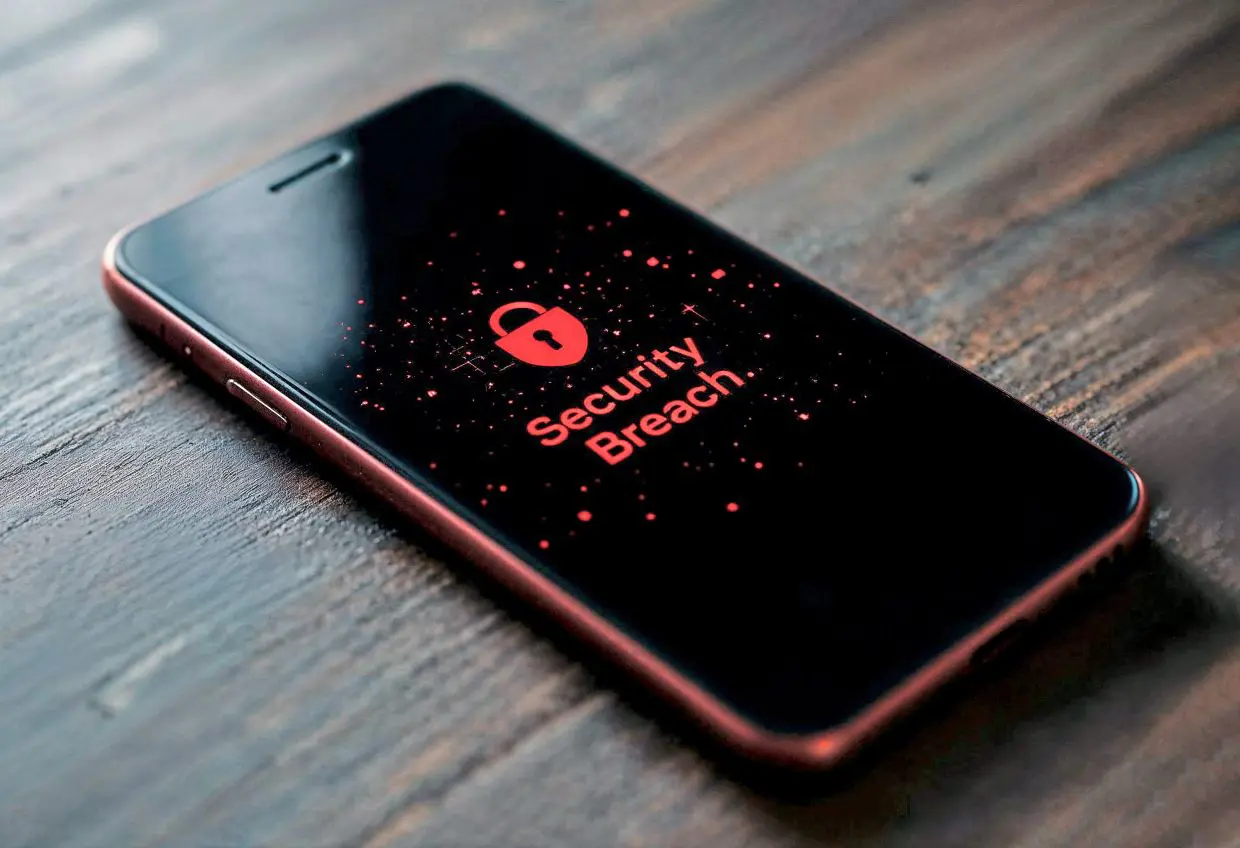
Compromised: Scammers are finding more sophisticated ways to bypass safeguards, such as malicious apps disguised as legitimate services. — Pic from magnific.com

PETALING JAYA: As smartphones become central to banking and daily life, scammers are finding increasingly sophisticated ways to seize control of the devices and the accounts within.

Universiti Sains Malaysia Cybersecurity Research Centre director Prof Dr Selvakumar Manickam said criminals were now turning to remote-access tools and malicious applications to bypass conventional scam safeguards.

He said victims could be persuaded to install apps such as AnyDesk or TeamViewer or malicious Android Package Kit (APK) files disguised as legitimate banking, delivery or other services.

Once installed and given permissions such as accessibility access, scammers could potentially view and operate the victim’s phone, including banking applications.

“An unsolicited caller asking the victim to download an app to ‘resolve’ an issue, a request to enable accessibility, SMS or ‘install unknown apps’ permissions, or being asked to remain on a call while installing something, should raise alarm bells,” he said when contacted.

Unexpected battery drain or unusual phone behaviour after installing an application, particularly one downloaded outside authorised sources, are also warning signs.

Selvakumar said scammers were increasingly exploiting psychology rather than simply trying to defeat technical security measures.

“They may create a sense of urgency by claiming a bank account has been frozen, a police matter needs to be resolved or an unpaid bill requires immediate action.

“Generative AI is also making scams more convincing with criminals able to produce polished phishing messages in local languages and clone voices to impersonate family members, bank officers or government officials,” he said.

Beyond screen control, malware can quietly intercept SMS messages and push notifications, including one-time passwords and two-factor authentication codes, before forwarding them to scammers.

Some newer malware could also identify a victim’s SIM card and mobile carrier before subscribing them to premium services through mobile billing systems.

“Fake cellular base stations have also been detected locally, allowing criminals to send fraudulent SMS messages while bypassing some telco-level filtering,” he added.

Selvakumar said the affected phone should subsequently be reset after important data has been backed up or checked by a trusted technician.

“The lesson is simple – never allow urgency or fear to override basic security precautions,” he said.

Cybersecurity expert Fong Choong Fook said social engineering remained one of the biggest threats despite growing public awareness.

“Don’t install any unknown or suspicious software. Have good practices such as not clicking on links from strangers or SMS,” he said.

Fong added that scammers impersonating bank employees, law enforcement officers and government officials could now use AI-generated voice and video to make their identities appear more convincing.

“Users should avoid public WiFi where possible as compromised networks could expose devices to additional risks.”

‘I watched them take control of my phone remotely’


PETALING JAYA: A routine phone call can quickly turn into a financial nightmare when unsuspecting victims lose control of their smartphones to scammers.

Confidential information and other personal details will then be manipulated by these fraudsters, causing financial and emotional distress to the victims.

For a Shah Alam resident who wished to be known only as Lim, the scam started with a phone call from a “bank officer”, warning him about suspicious transactions.

The caller instructed him to download an application, purportedly to verify his identity and secure his account.

Thinking he was following a security procedure, Lim installed the application and granted the requested authorisation.

“After installing it, it seemed that someone had taken control of my phone.

“I could see apps opening by themselves, but I could not control what was happening,” said the 42-year-old.

Within minutes, the scammers had gained access to his banking application and made several transactions.

Lim claimed that he lost about RM7,800 from his account before he managed to disconnect the phone from the Internet and contacted the bank.

“I always thought scams happened because people clicked suspicious links.

“I never expected that scammers could take over my phone while I was still holding it.

“By the time you realise it is the work of a scammer, it is too late, as you have probably already suffered financial losses,” he said.

Another victim, who wished to be known as Tan, 56, from Ipoh, said she was contacted through WhatsApp on July 1.

The caller informed her that she had won a RM3,000 prize and was offered a choice between shopping vouchers or cash credited to her e-wallet.

Tan said she opted for a cash reward, and the call was subsequently transferred to a “manager”, who sounded like a foreigner.

“I just followed his instruction to claim the reward.

“He then took control of my phone screen and kept directing me from one site to another without giving me time to think,” she said.

Tan said she then contacted the platform’s customer service through the app, activated the kill switch and lodged a police report within an hour.

She also said the official complaint submitted through the app, together with screenshots and supporting documents, later disappeared from her phone.

Tan claimed that RM4,500 was charged to her pay-later account while another RM6,000 was withdrawn through the platform’s loan facility, bringing her total losses to RM10,500.

“The RM6,000 purported loan was converted into a 24-month repayment plan, requiring a monthly instalment of over RM300.

“The sum of RM4,500 was transferred to an entity listed as ‘Lucky Boy Trading’, although I had not purchased any items,” she said.

A victim from Subang, who identified himself as Ravi, 35, said scammers posing as delivery company employees convinced him to install an application to reschedule a parcel.

After granting the application access to his phone, he noticed that messages and notifications were appearing and disappearing without his involvement.

“I thought I was only following instructions to receive a parcel. I never expected them to be able to take control of my phone.”

Friday, August 7, 2026

When ‘be careful’ is not enough


PETALING JAYA: “Be careful.” These are caring words often told to older persons to watch their step.

But fall prevention requires more than simply telling the ­senior citizen to “be careful”, said Prof Dr Tan Maw Pin, a professor in geriatric medicine at Universiti Malaya Medical Centre.

But fall prevention requires more than simply telling the ­senior citizen to “be

Malaysia, she said, has yet to implement a coordinated natio­nal falls prevention strategy despite the National Health and Morbidity Survey 2025 report stating that about 15% of Malaysians aged 60 and above fall at least once a year.

“Getting the statistics is important but it must lead to policy, investment, implementation and evaluation,” she said.

According to the World Health Organization, falls are the second leading cause of unintentional injury deaths worldwide, with adults older than 60 suffering the highest number of fatal falls.

ASLO READ: Easing big fears of small falls with home modifications

Dr Tan said a fall should never be dismissed as a normal part of ageing.

ASLO READ: Easing big fears of small falls with home modifications

Dr Tan said a fall should never be dismissed as a normal part of ageing.

“The likelihood of falling – and of sustaining a serious injury – rises with age, frailty, muscle weakness, osteoporosis and chronic illness.

“A fall may cause a hip fracture, head injury, bleeding or other fractures,” she added.

Dr Tan cautioned that its consequences frequently extend beyond the immediate injury.

“An older person may become afraid of falling again, reduce their activity, lose muscle strength and become increasingly depen­dent.

“Some never regain their previous mobility or indepen­dence,” she explained.

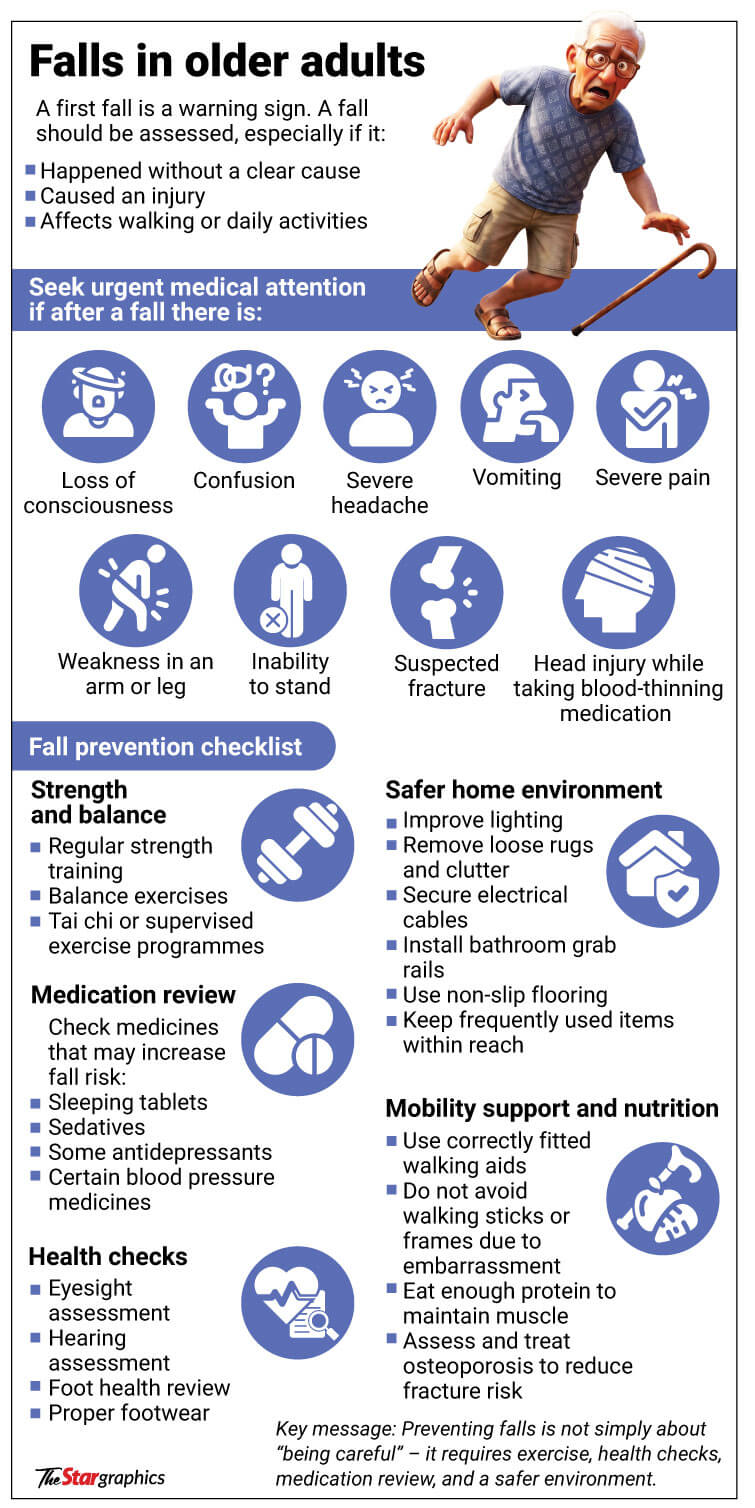
A first fall should be regarded as a warning sign warranting assessment, particularly if it is unexplained or results in injury, Dr Tan noted.

'CLICK TO ENLARGE'
'CLICK TO ENLARGE'

“Anyone who develops loss of consciousness, confusion, severe headache, vomiting, weakness of an arm or leg, inability to stand, severe pain or a suspected fracture after a fall should receive urgent medical attention.

“People taking blood-thinning medication should also be assessed promptly following a head injury, even if they initially appear well,” she added.

Dr Tan also said medication such as sedatives, some antidepressants and certain blood-pressure medicines might cause drowsiness or a sudden drop in blood pressure.

“Eyesight, hearing, foot problems and footwear should also be assessed.”

Dehydration and medication side effects might also precipitate a fall, she said.

“Some falls result from heart rhythm abnormalities or fainting and should not automatically be blamed on ageing or clumsiness,” Dr Tan added.

ASLO READ: Never too late for stronger muscles and safer steps

“Mental and neurological factors are equally relevant. Dementia may affect judgement, attention and awareness of ­hazards.”

She said older folk should exercise regularly to improve muscle strength and balance, adding that this could include supervised strength training, balance exerci­ses or tai chi.

“At home, carers can improve lighting, remove loose rugs and clutter, secure electrical cables, install grab rails in bathrooms, provide non-slip flooring and ensure frequently needed items are within easy reach,” Dr Tan advised.

“Walking aids must be correctly fitted and used consistently. Older people should not feel embarrassed about using a walking stick or frame.”

While Malaysia has made progress in public spaces, Dr Tan said it is not yet consistently age-­friendly.

“Newer facilities may provide ramps, lifts and accessible toilets, but the routes leading to them may still contain broken or uneven pavements, poorly placed drains, slippery surfaces, inadequate lighting or missing handrails,” she said.

Association for Residential Aged Care Operators of Malaysia president Delren Terrence Douglas said many towns and ­cities are still not designed with the needs of senior citizens in mind, making everyday activities such as walking, shopping or visi­ting public parks unnecessarily difficult.

He said in some malls and parks, elderly people often have to keep walking despite feeling tired because there are few places to sit and rest.

“A shortage of benches, handrails and accessible ramps leaves many seniors struggling to complete even short journeys,” he added.

Saturday, August 1, 2026

AI ecosystem to get new legal framework, a pro­posed solu­tion for global AI gov­ernance


Governance Bill will not apply to personal use

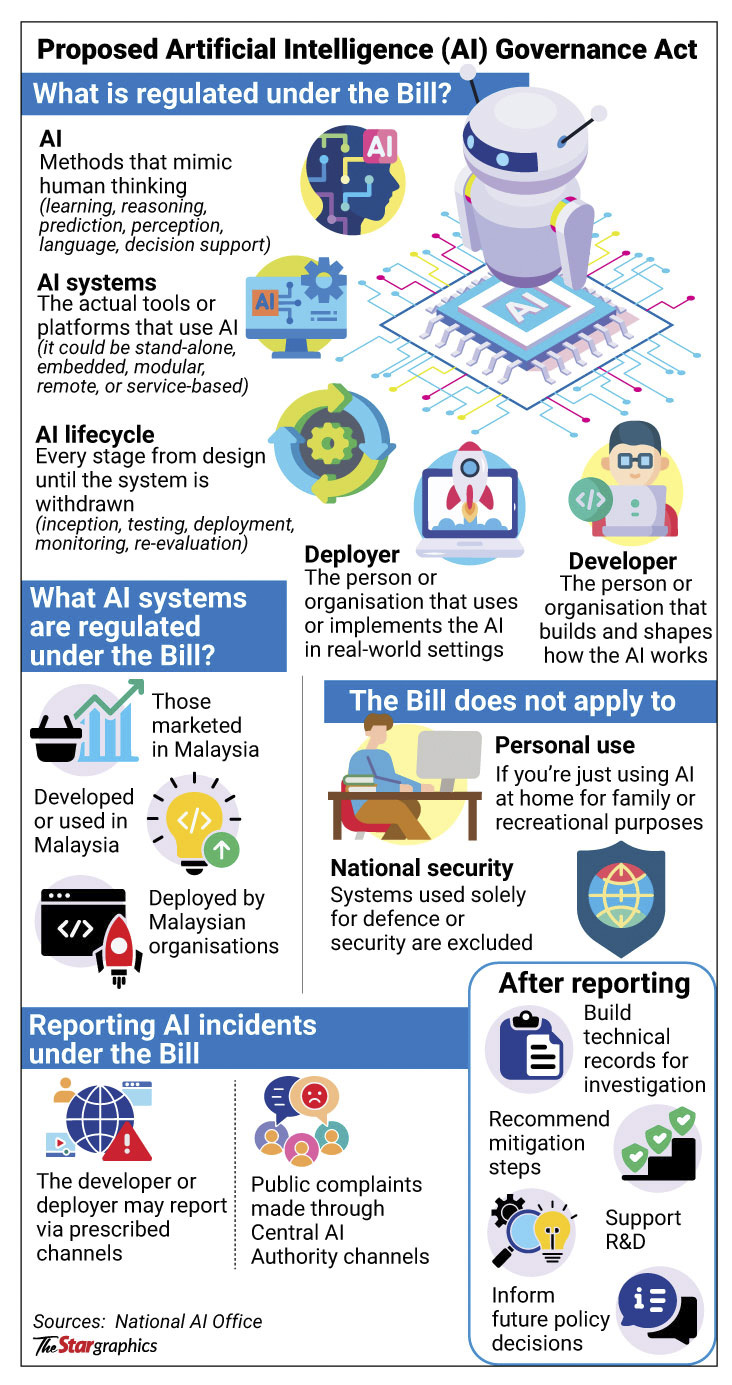
PETALING JAYA: Artificial intelligence (AI) systems, the AI lifecycle, as well as AI developers and deployers, are set to be regulated under the proposed Artificial Intelligence Governance Bill.

However, the Bill will not apply to the personal use of AI or on matters of national security.

Intended to serve as a national legal framework for the safe, responsible and innovation-enabling use of AI, the law will apply to systems placed on the Malaysian market or put into service in Malaysia.

ALSO READ: Evolving AI could outpace regulation, warn experts

It will also apply to AI systems designed, developed or used here, as well as those used by deployers set up in Malaysia, regardless of where the systems are physically hosted.

The proposed AI Governance Act is guided by five key principles: protecting human dignity and rights, transparency and explainability, accountability, safety and security, and responsible data governance.

Together, these principles provide the foundation for the responsible development, deployment and use of AI systems, while promoting trustworthy AI, innovation and public confidence.

CLICK TO ENLARGE
CLICK TO ENLARGE

According to the public consultation document released by the National AI Office (NAIO), the Bill will adopt a principle-based approach by setting out national AI Governance Principles to guide the responsible development, deployment and use of AI, with implementation supported through standards, guidelines and other instruments.

It also adopts a risk-based approach, with regulatory obligations proportionate to an AI system's level of risk, categorised into three levels: unacceptable, high and low.

This means that higher-risk systems will face stricter governance requirements while lower-risk applications will be subject to lighter obligations.

The risk framework is anchored on “harm”, which includes death, bodily injury, unlawful deprivation of fundamental liberty anchored to the Federal Constitution, and the contravention of any written law.

The Bill also categorise AI incidents to include failures, weaknesses, misuse, unexpected effects and near misses.

It will also require incidents to be reported, including the nature of the incident, its foreseeable harm, the containment measures taken, the root cause (where applicable), and the remediation actions implemented.

The Bill also proposes a central AI authority as the principal national body for AI governance, whose role will be to oversee and operate the national “baseline” principles and standards to strengthen the overall AI ecosystem by addressing gaps in capacity across sectors.

The authority will oversee AI safety by maintaining a risk framework, supervising assessments, supporting testing, developing incident reporting mechanisms and engaging in international technical cooperation.

It will also be responsible for investigations and enforcement, including technical fact-finding when AI incidents occur, determining what happened, identifying the systems and actors involved, as well as producing findings to support corrective actions.

In addition, it will carry out capacity-building functions for the public sector by developing guidance, templates, training and practical support for public authorities, regulators, AI sandbox operators or overseers, and regulated organisations to help them comply with the framework.

The authority may also appoint "Sectoral Leads", who will be delegated specific powers under the Bill to support the implementation of the framework, where they have the legal authority, technical expertise and governance capacity.

The proposed amendments in the document are not final and remain subject to further review and amendment.

Digital Minister Gobind Singh Deo said in June that the government will adopt a two-pronged approach by using existing laws to prosecute those who misuse content, while also drafting the AI Governance Bill to further strengthen prevention and accountability throughout the technology’s lifecycle.

He said the move is aimed at ensuring that risks posed by high-capability technologies such as deepfakes, synthetic content and identity manipulation can be addressed at an early stage.

Ultimately, according to the public consultation document, the Bill aims to set up a central oversight framework that works alongside existing sectoral regulators to enable coordinated governance while addressing industry-specific risks and operational needs.

“This will allow public bodies, including existing regulators, to collaborate within a common governance framework, while retaining the flexibility to address sector-specific risks and operational needs,” it said.

The NAIO will be launched tomorrow.

Related stories:
20 Jul 2026The speech focused on China's governance philosophy of prioritising AI risk prevention and control while advancing secure, controllable, and ...Read more