src='https://pagead2.googlesyndication.com/pagead/js/adsbygoogle.js?client=ca-pub-2513966551258002'/> Rightways: Cybersecurity Infolinks.com, 2618740 , RESELLER

Pages

Share This

Deepseek https://www.deepseek.com/./深度求索 DeepSeek | 深度求索 https://askaichat.app/chat
Showing posts with label Cybersecurity. Show all posts

Monday, September 7, 2026

Free AI skills for 100,000 youths - AI COURSES

Ai Untuk rakyat pro­gramme offers train­ing, three months’ access to premium tools

CLICK TO ENLARGE

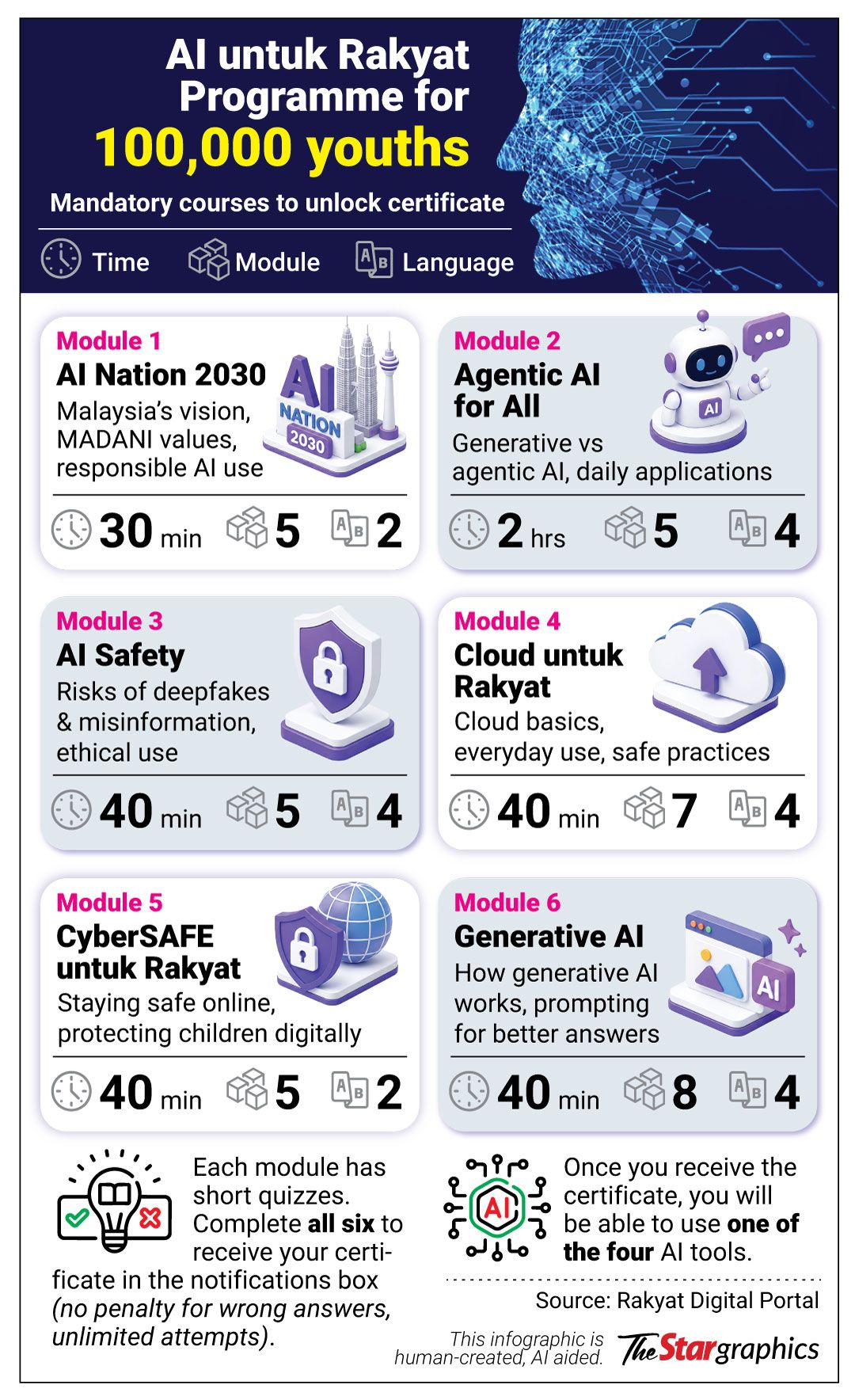
PETALING JAYA: Some 100,000 Malaysian youths will have the opportunity to strengthen their digital skills and gain hands-on artificial intelligence (AI) experience under the government’s AI Untuk Rakyat programme.

Upon completing six self-paced modules, participants can access premium AI tools for academic work, creative projects and ­professional tasks, including Google’s Gemini, YTL’s ILMUChat, Alibaba Cloud’s MuleRun and WonderClip.

The modules have no time limit, but participants must complete each subsection before progressing.

Explanations are in simple English and Bahasa Malaysia.

To begin, applicants must log into the Rakyat Digital portal by scanning a QR code with their MyDigital ID, then access the six courses through the dashboard.

The first module outlines Malay­sia’s AI goals, linking the programme to the government’s economic framework to “raise the ceiling” by growing national wealth and “raise the floor” by improving living standards.

It also explains how AI should benefit Malaysians while streng­thening the country’s AI capabi­lities.

The module outlines six govern­ment core values – sustainability, prosperity, compassion, trust, respect and innovation – and how they apply to AI.

Participants are reminded that AI should be used responsibly, shared fairly and developed to benefit people and the environment.

The second module introduces youths to agentic AI systems that can take initiative instead of ­waiting for user prompts.

Learners explore its history, mechanics and applications through exercises using Copilot and ChatGPT.

The portal said the course demonstrates how agentic AI can handle everyday tasks, helping users direct technology to work for them.

The third module focuses on building trustworthy AI, stressing fairness, transparency, accoun­tability, privacy and human- centric design.

Learners explore positive and negative applications of deepfakes and why the challenge lies not in the technology itself, but in how it is used.

Local case studies show how the lessons can be applied.

The fourth module introduces cloud computing, allowing users to store data, run applications and access computing resources without expensive hardware.

“There are three common core cloud services which are Infra­structure as a Service (IaaS), Platform as a Service (PaaS) and Software as a Service (SaaS).

“Each offers unique benefits tailored to different organisa­tional needs,” the portal said.

The fifth module – CyberSAFE untuk Rakyat – covers cyber­security and personal data protection, ­explai­ning threats such as ­malware, phishing and ransomware.

It highlights antivirus software, strong passwords, multi- factor authentication as well as regular updates.

It also explains the regulatory framework under personal data protection laws, including child­ren’s online safety, open communication, parental controls and active supervision.

The final module traces AI’s evolution from systems that ­analyse data to generative AI that creates text, images and music.

“Learners are introduced to prompting techniques, the advantages and challenges of gene­rative AI and key buzzwords such as natural language processing (NLP) and large language models (LLMs).

“The aim is to give participants both conceptual understanding and practical skills to engage confidently with modern AI tools,” the portal said.

After completing the modules, participants can redeem one of the four AI tools free for three months.

In a statement on Aug 30, the Digital Ministry said the initiative would give youths opportunities to explore advanced technology, enhance creativity, productivity and digital skills, and build ­confidence in using emerging technologies responsibly.

“This is in line with Malaysia’s aspiration to develop an inclusive AI Nation by 2030, aligned with the Malaysia Digital 2030 aspirations,” it said.

The programme was anno­unced by Prime Minister Datuk Seri Anwar Ibrahim during the 2026 National Day Premier Address at the Putrajaya Inter­national Convention Centre on Aug 30.

NOTES:

To log in to the Rakyat Digital portal and access your courses, follow these sequential steps:
  1. Open the Rakyat Digital portal on your computer or tablet web browser.
  2. Select the MyDigital ID login option on the main sign-in page to display the unique QR code.
  3. Open the MyDigital ID app on your smartphone.
  4. Tap the QR scanner icon within the app interface.
  5. Scan the QR code displayed on your computer screen using your phone's camera.
  6. Authenticate the request on your phone by entering your PIN or using biometrics (fingerprint/face recognition).
  7. Navigate the dashboard on your computer screen once the portal redirects you.
  8. Click on the courses section to view and start your six enrolled courses.
Are you experiencing any specific error messages while scanning, or do you need help navigating the dashboard once you are logged in?
A modern, accessible learning platform for digital skills.
Missing: .open


Monday, August 10, 2026

Don’t install apps under pressure, ‘I watched them take control of my phone remotely’


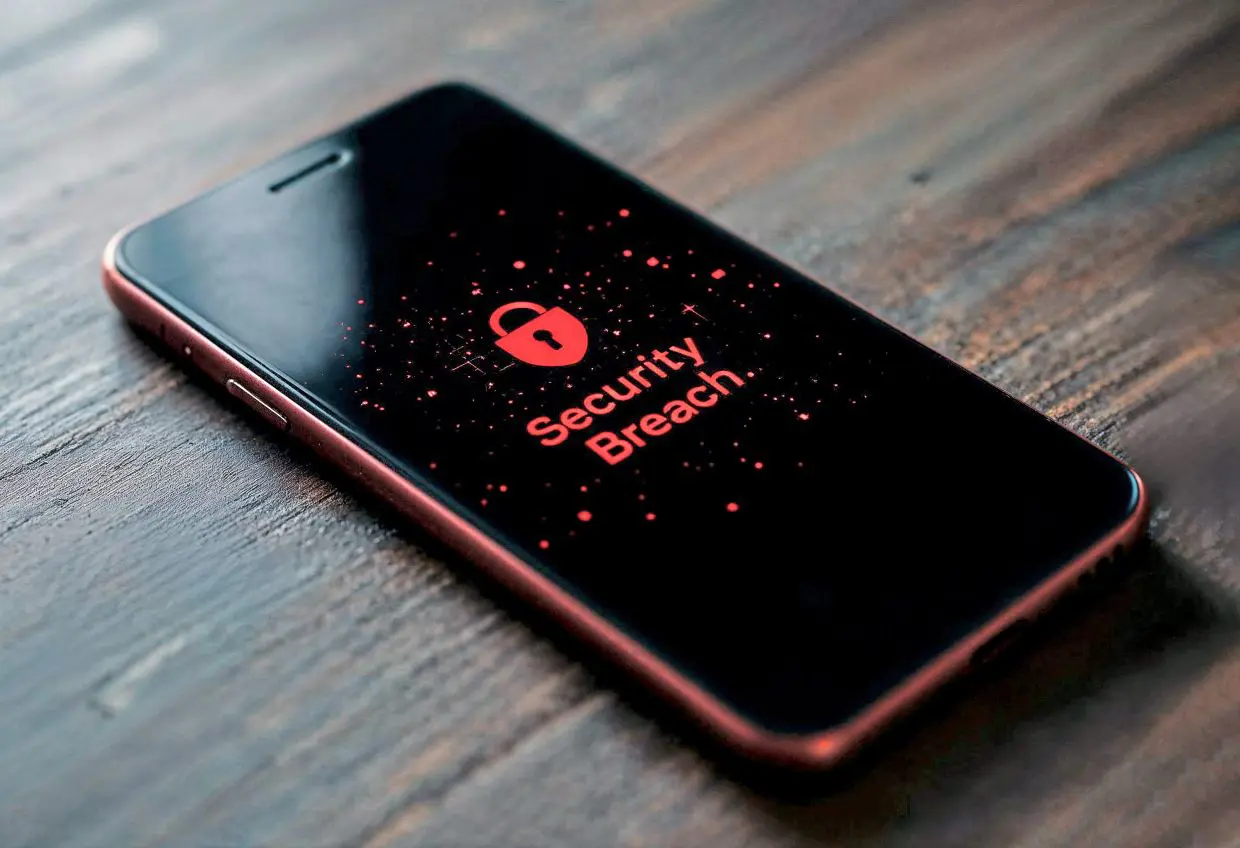
Compromised: Scammers are finding more sophisticated ways to bypass safeguards, such as malicious apps disguised as legitimate services. — Pic from magnific.com

PETALING JAYA: As smartphones become central to banking and daily life, scammers are finding increasingly sophisticated ways to seize control of the devices and the accounts within.

Universiti Sains Malaysia Cybersecurity Research Centre director Prof Dr Selvakumar Manickam said criminals were now turning to remote-access tools and malicious applications to bypass conventional scam safeguards.

He said victims could be persuaded to install apps such as AnyDesk or TeamViewer or malicious Android Package Kit (APK) files disguised as legitimate banking, delivery or other services.

Once installed and given permissions such as accessibility access, scammers could potentially view and operate the victim’s phone, including banking applications.

“An unsolicited caller asking the victim to download an app to ‘resolve’ an issue, a request to enable accessibility, SMS or ‘install unknown apps’ permissions, or being asked to remain on a call while installing something, should raise alarm bells,” he said when contacted.

Unexpected battery drain or unusual phone behaviour after installing an application, particularly one downloaded outside authorised sources, are also warning signs.

Selvakumar said scammers were increasingly exploiting psychology rather than simply trying to defeat technical security measures.

“They may create a sense of urgency by claiming a bank account has been frozen, a police matter needs to be resolved or an unpaid bill requires immediate action.

“Generative AI is also making scams more convincing with criminals able to produce polished phishing messages in local languages and clone voices to impersonate family members, bank officers or government officials,” he said.

Beyond screen control, malware can quietly intercept SMS messages and push notifications, including one-time passwords and two-factor authentication codes, before forwarding them to scammers.

Some newer malware could also identify a victim’s SIM card and mobile carrier before subscribing them to premium services through mobile billing systems.

“Fake cellular base stations have also been detected locally, allowing criminals to send fraudulent SMS messages while bypassing some telco-level filtering,” he added.

Selvakumar said the affected phone should subsequently be reset after important data has been backed up or checked by a trusted technician.

“The lesson is simple – never allow urgency or fear to override basic security precautions,” he said.

Cybersecurity expert Fong Choong Fook said social engineering remained one of the biggest threats despite growing public awareness.

“Don’t install any unknown or suspicious software. Have good practices such as not clicking on links from strangers or SMS,” he said.

Fong added that scammers impersonating bank employees, law enforcement officers and government officials could now use AI-generated voice and video to make their identities appear more convincing.

“Users should avoid public WiFi where possible as compromised networks could expose devices to additional risks.”

‘I watched them take control of my phone remotely’


PETALING JAYA: A routine phone call can quickly turn into a financial nightmare when unsuspecting victims lose control of their smartphones to scammers.

Confidential information and other personal details will then be manipulated by these fraudsters, causing financial and emotional distress to the victims.

For a Shah Alam resident who wished to be known only as Lim, the scam started with a phone call from a “bank officer”, warning him about suspicious transactions.

The caller instructed him to download an application, purportedly to verify his identity and secure his account.

Thinking he was following a security procedure, Lim installed the application and granted the requested authorisation.

“After installing it, it seemed that someone had taken control of my phone.

“I could see apps opening by themselves, but I could not control what was happening,” said the 42-year-old.

Within minutes, the scammers had gained access to his banking application and made several transactions.

Lim claimed that he lost about RM7,800 from his account before he managed to disconnect the phone from the Internet and contacted the bank.

“I always thought scams happened because people clicked suspicious links.

“I never expected that scammers could take over my phone while I was still holding it.

“By the time you realise it is the work of a scammer, it is too late, as you have probably already suffered financial losses,” he said.

Another victim, who wished to be known as Tan, 56, from Ipoh, said she was contacted through WhatsApp on July 1.

The caller informed her that she had won a RM3,000 prize and was offered a choice between shopping vouchers or cash credited to her e-wallet.

Tan said she opted for a cash reward, and the call was subsequently transferred to a “manager”, who sounded like a foreigner.

“I just followed his instruction to claim the reward.

“He then took control of my phone screen and kept directing me from one site to another without giving me time to think,” she said.

Tan said she then contacted the platform’s customer service through the app, activated the kill switch and lodged a police report within an hour.

She also said the official complaint submitted through the app, together with screenshots and supporting documents, later disappeared from her phone.

Tan claimed that RM4,500 was charged to her pay-later account while another RM6,000 was withdrawn through the platform’s loan facility, bringing her total losses to RM10,500.

“The RM6,000 purported loan was converted into a 24-month repayment plan, requiring a monthly instalment of over RM300.

“The sum of RM4,500 was transferred to an entity listed as ‘Lucky Boy Trading’, although I had not purchased any items,” she said.

A victim from Subang, who identified himself as Ravi, 35, said scammers posing as delivery company employees convinced him to install an application to reschedule a parcel.

After granting the application access to his phone, he noticed that messages and notifications were appearing and disappearing without his involvement.

“I thought I was only following instructions to receive a parcel. I never expected them to be able to take control of my phone.”

Sunday, May 24, 2026

Enhance fraud detection, checking banking fraud


CLICK TO ENLARGE

CLICK TO ENLARGE


Calls for improvements in detecting suspicious banking transactions

The issue has come under renewed focus following a Sessions Court ruling ordering a bank to compensate a customer RM166,000 over suspicious online transactions that went undetected.

As scams evolve, banks are facing heightened urgency to identify unusual transaction patterns and act fast, particularly as fraudsters exploit human behaviour and then move in to breach banking systems.

At a Bank Negara workshop on consumer protection and fair conduct reforms, its officers said existing laws protect the confidentiality of customer information and personal data in the financial sector.

“Financial institutions are robust but there is always room for improvements,” the officers said yesterday.

They said enforcement actions had been taken in instances where breaches were identified, including requiring the institutions involved to implement corrective action plans.

The officers also said Bank Negara continued to monitor banks on consumer protection and compliance matters.

In its latest annual report, the central bank stressed the need to strengthen fraud detection systems and reinforce internal safeguards to combat sophisticated online scams.

The central bank said banks and non-bank financial institutions were required to adopt advanced fraud detection measures and strengthen internal safeguards to quickly intercept suspicious transactions.

It also stressed for a proactive approach to prevent fraudulent transactions from escalating.

The central bank said that in recent years, financial institutions had strengthened various security measures including tighter fraud detection rules and triggers, cooling-off periods for new device registrations and stronger authentication methods.

These measures contributed to a 52% decline in unauthorised fraudulent transactions involving malware and phishing reported in 2024, and prevented over Rm399mil in attempted fraudulent transactions, it said.

However, Bank Negara also acknowledged that fraud patterns were becoming increasingly complex and harder to distinguish from genuine customer activity.

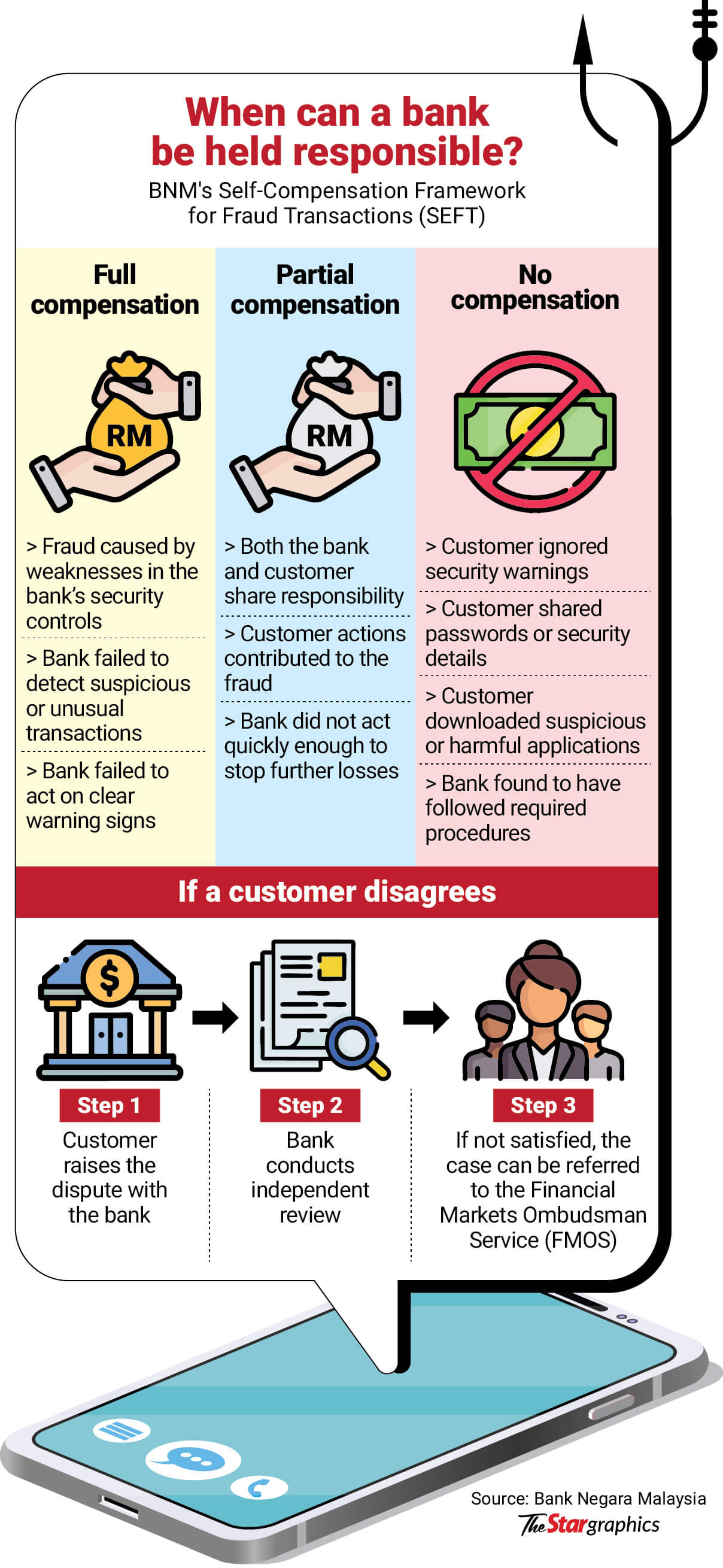
Bank Negara said banks and consumers shared responsibility for safeguarding digital banking security, but reiterated that financial institutions had to determine whether weaknesses in their internal controls contributed to fraud incidents.

It also introduced the Selfcompensation Framework for Fraud Transactions (SEFT) under its Policy Document on Ensuring Fair Treatment for Victims of Unauthorised e-banking Transactions.

SEFT outlines how banks should assess fraud cases and determine compensation based on the responsibilities of both financial institutions and customers.

According to Bank Negara, more than 95% of online fraud cases in Malaysia involved authorised transactions – where victims were manipulated into willingly transferring money to scammers.

Federation of Malaysian Consumers Associations (Fomca) vice-president Datuk Indrani Thuraisingham agreed that banks should adopt more proactive intervention measures when transactions appear inconsistent with a customer’s normal behaviour.

“Banks are clearly not doing enough. Fraudsters now exploit human behaviour more than banking systems,” she said.

“Banks must transition from passive logging to active, pre-emptive intervention.”

https://www.thestar.com.my › nation › 2026/05/22 › sle...

Related post:

Banks must rethink fraud controls as AI risks rise