src='https://pagead2.googlesyndication.com/pagead/js/adsbygoogle.js?client=ca-pub-2513966551258002'/> Rightways: rightways Infolinks.com, 2618740 , RESELLER

Pages

Share This

Deepseek https://www.deepseek.com/./深度求索 DeepSeek | 深度求索 https://askaichat.app/chat
Showing posts with label rightways. Show all posts

Saturday, October 24, 2026

China issues guidelines to boost AI-driven job creation, mitigate employment displacement risks

Staff members conduct data collection for various scenarios at a company’s embodied?AI robot data collection and training center in Suqian, East China’s Jiangsu Province on September 3, 2026. Through real-robot simulation, on-site operations, and human-robot collaboration, the center precisely captures multi-dimensional core data such as vision, motion, and environment data, laying a solid data foundation for the optimization and iteration of embodied-AI models. Photo: VCG


China has rolled out a set of policy measures to create more jobs through artificial intelligence (AI), improve employment quality and mitigate the impact of job displacement resulting from AI applications, helping build an employment-friendly development model, amid the rapid development and growing use of the technology.

The guidelines, issued by the General Office of the State Council and made public on Friday, outline 18 major tasks across six areas, covering AI-driven job creation, employment-friendly AI adoption, workforce training, employment services, labor rights and social security protections, and employment risk monitoring and response.

The document aims to strengthen AI's positive role in creating job opportunities, enhancing traditional jobs through AI, improving employment quality and stimulating entrepreneurship, while mitigating the impact of AI-related job displacement, according to the guidelines.

It also seeks to promote inclusive development by ensuring that technological progress and industrial upgrading go hand in hand with employment growth and improvements in people's livelihoods.

To strengthen AI's job creation potential, the guidelines call for expanding employment opportunities in emerging sectors, helping micro, small and medium-sized enterprises retain and expand their workforce, developing new AI-related employment and entrepreneurship models, and accelerating the development of new AI-related occupations.

The document also calls for building an employment-friendly pathway for AI adoption, including tapping the employment potential of AI in traditional industries, easing job displacement pressures arising from AI applications and establishing mechanisms to assess employment risks associated with the technology.

To improve workers' digital literacy and employability, the guidelines call for coordinated efforts to develop innovative AI talent and the implementation of dedicated AI training programs.

In terms of employment services, the document calls for using AI to facilitate the implementation of employment policies, improve the intelligence and efficiency of employment services, and strengthen support for workers transitioning to new jobs or occupations.

The guidelines also emphasize improving labor rights and social security systems to keep pace with technological changes. Measures include improving labor rights protections to accommodate human-AI collaboration, improving social security arrangements for flexible workers and those in new forms of employment, and refining income distribution mechanisms to adapt to AI development.

To address potential employment risks arising from AI applications, the document proposes strengthening employment risk monitoring and early-warning systems related to AI applications, stepping up research into AI's impact on employment, and improving mechanisms to respond to emerging employment risks.

The guidelines call on local governments and relevant departments to implement the measures in accordance with local conditions. Human resources and social security authorities and development and reform departments at all levels are also urged to strengthen coordination to ensure the measures are effectively implemented.

The latest guidelines are in line with a five-year plan for implementing the employment-firs initiative, fostering more entrepreneurial projects involving innovative AI applications andt strategy released by the State Council in June, which called for advancing the "AI Plus" the commercialization of technological achievements, exploring new forms of work involving human-AI collaboration, and strengthening AI's role in job creation.


Source link : https://www.globaltimes.cn/page/202610/1372863.shtml 

RELATED ARTICLES

Ninety years on, the great Long March spirit is a light shining on the world


Marching toward prosperity.

The great Long March spirit has been deeply etched into the DNA of Chinese society. It is the determination to rise to challenges and to persist for the long haul; it is the courage to fear no sacrifice and to dare to try; it is the clarity to face reality and actively seek change; and above all, it is the original aspiration of standing with the people through life and death, sharing weal and woe, and striving arduously.

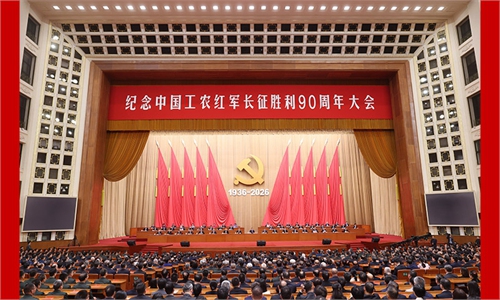
The 90th anniversary of the victory of the Long March of the Chinese Workers' and Peasants' Red Army was commemorated at a grand gathering in Beijing on Thursday morning. General Secretary of the Communist Party of China (CPC) Central Committee Xi Jinping, also Chinese president and chairman of the Central Military Commission, attended the gathering and delivered an important speech.

Xi stressed that the great spirit of the Long March demonstrates the power of loyalty, truth, justice and unity. As an important part of the spiritual lineage of the CPC, it transcends time and space and remains evergreen. It will always be a precious treasure and a powerful driving force inspiring us to overcome difficulties and forge ahead courageously. 

The Long March was a beam of light that burst forth from the Chinese nation at its darkest hour. It showed the world clearly that, even in an old China mired in darkness with no visible way out, there was a group of people striving with all their might to build a new China. In the book The Life Millennium: The 100 Most Important Events and People of the Past 1000 Years, published by the American Time-Life Books, scholars from around the world jointly selected 100 events that shaped the world from 1000 to 2000 AD. The Long March of the Red Army was one of three historical events from China to make the list. It profoundly inspires people that as long as one remains firm in will and unyielding in the face of setbacks, a way out can always be found through continuous exploration, and an entirely new path can be opened.

From Edgar Snow to Henry Kissinger, from Nelson Mandela to Fidel Castro, many observers and strategists have pondered why this Long March in the East was able to succeed. To this day, whenever China astonishes the world with technological breakthroughs or reshapes perceptions with development miracles, the world still asks: "How do the Chinese do it?" These questions all point to the same answer: We have found the right path - a path of never yielding, always moving forward, and never retreating. The Long March is both a spiritual treasure that inspires the Chinese people and a display of the Chinese nation's resilient character to the world.

Today, the term "Long March" has become a shared name for any arduous journey that ultimately reaches its destination. In this sense, the value of the Long March lies not only in the arrival itself, but in the act of continuing to set forth, again and again. After the victory of the Long March, the nation did not stop: It kept marching through the flames of the War of Resistance Against Japanese Aggression, kept advancing on the tide of reform and opening-up, and continues to advance under the call of the new era, all the way toward the great rejuvenation of the Chinese nation. 

Today, the great Long March spirit has been deeply etched into the DNA of Chinese society. It is the determination to rise to challenges and to persist for the long haul; it is the courage to fear no sacrifice and to dare to try; it is the clarity to face reality and actively seek change; and above all, it is the original aspiration of standing with the people through life and death, sharing weal and woe, and striving arduously.

Ninety years on, the great Long March spirit no longer belongs only to history; it is a light that grows ever brighter and shines upon the world. Currently, global governance is experiencing a "darkest hour": climate change, the North-South divide, geopolitical conflicts, and the undercurrents of deglobalization. 

Old paradigms are failing, and new rules have yet to take shape. Solving many major issues requires long-term planning and sustained effort that transcend political cycles and short-term gains and losses. 

The spirit of firm conviction, unity and cooperation, and unyielding struggle transcends national borders and ideologies. It inspires humanity to overcome adversity and pursue a brighter future. This both suggests that global governance needs to blaze new trails toward common development, common security, and common prosperity, and helps the world better understand the spiritual bedrock of the Chinese nation, enabling outsiders to better grasp where this "enabling great power" is heading. 

"Where the spirit lies, there lies the strength." The great Long March spirit resonates with the Chinese nation's cultural tradition of constant self-improvement and has gained new contemporary meaning in the process of Chinese modernization. While it is no longer possible for China today to replicate the march back then, this spirit will always remain, proving to the world that the Chinese nation possesses extraordinary resilience. 

After decades of struggle, China has long since become the world's second-largest economy and is comprehensively advancing the great rejuvenation of the Chinese nation through Chinese modernization. 

The enduring national resilience behind the great Long March spirit has been a key factor in creating this development miracle. It is the confidence that allows China to navigate storms and seize the historical initiative, and it also provides a stabilizing expectation for a world full of uncertainty.

In the 1980s, Zbigniew Brzezinski, who once served as US national security advisor, walked with his family along the route once taken by the Red Army. He later reflected: "The Long March is more than an epic of almost unmatched heroism." Today, more and more foreigners are coming to China to retrace the Long March route, and places like Loushan Pass have once again become a popular destination for visitors. This is one indication that the great Long March spirit is increasingly needed by the world. As a spiritual monument that the Chinese nation has offered to the world, its importance will become even more prominent in the future. As military writer Wang Shuzeng once described: "The Long March belongs to that category of events in human history which, even after the passage of long years, continue to be sought after by people." 

"The history of the Long March has never faded; the road of the Long March continues to extend." For China, on the new journey, the Long March has no endpoint. 

To carry forward the great Long March spirit is to always maintain a high-spirited posture of storming passes and seizing fortresses, to continue the arduous trek on the journey of Chinese modernization, and to respond to all risks and challenges with an unstoppable fighting spirit. It is to both successfully navigate the Long March of our own generation and infuse a world marked by turbulence and transformation with confidence and strength from the East.

Source link: https://www.globaltimes.cn/page/202610/1372832.shtml

RELATED ARTICLES

Wednesday, October 21, 2026

Legacy of aid for stroke survivors


Yeo reflecting on Nasam’s 30-year journey and why its work is important.

Some 800 guests attended National Stroke Association of Malaysia’s (Nasam) fundraising dinner in Petaling Jaya, Selangor.

The event brought together stroke survivors, families, volunteers, healthcare professionals, corporate supporters, friends and well-wishers in a celebration of Nasam’s three decades of helping stroke survivors rebuild their lives.

A special flash-mob performance brought together stroke survivors’ Joyce Ng (41), Chee Kee Siong (71) and Christopher Ching (72), alongside volunteers and supporters in a joyful celebration through song.

The celebration in conjunction with the association’s anniversary and themed “30 Years of Hope” reflected the organisation’s commitment to troke  vivors and their families, Nasam said   in a media statement.

One of the evening’s highlights was the “Strokees Fashion Show”, which demonstrated that stroke did not have to define a person’s future.

Additional pix Nasam fundraising dinner 2026

Fourteen stroke survivors took to the catwalk with confidence, parading a collection of the latest batik designs sponsored by The Mod House.

Their appearance was more than a fashion show; it was a powerful statement of courage, recovery and renewed confidence, with the stroke survivors receiving enthusiastic support from the audience, Nasam said.

The Strokees’ Fashion Show participants taking centre stage in their batik outfits during the fundraising dinner. — Courtesy of Nasam’s Facebook page

Rare Green Vultures, a dynamic 10-person seniors jazz band, provided entertainment for the evening, and had the crowd singing along to their renditions of popular songs.

Stand-up comedian Douglas Lim then took to the stage and left the audience in stitches with his trademark humour.

There was also a flashmob performance that got participants taking part, besides sales of merchandise created by stroke survivors.

Additional pix Nasam fundraising dinner 2026

Nasam founder Janet Yeo delivered a personal and heartwarming speech reflecting on the organisation’s journey.

She spoke about the challenges Nasam faced and overcame throughout the years, as well as her own personal experience of suffering a stroke and the long journey towards regaining a meaningful and functional life.

Her story served as a powerful reminder of why Nasam’s work remains important, that recovery is possible, hope can be restored and that with the right support, stroke survivors can once again participate fully in life, the organisation said.

Nasam has grown from a pioneering stroke-support organisation into a nationwide network providing rehabilitation, education, support and advocacy for stroke survivors and their families.

Funds raised would enable the organisation to continue and expand its rehabilitation and support programmes for stroke survivors across Malaysia, said Nasam.

“Thirty years is a remarkable milestone, but more importantly, it represents 30 years of people refusing to give up.

“Every stroke survivor who takes another step, regains another skill or finds the confidence to return to everyday life represents another reason for hope,” the organisation said.


9 Oct 2026 — Nasam has grown from a pioneering stroke-support organisation into a nationwide network providing rehabilitation, education, support and ...Read more
Missing: PRESSREADER ‎| Show results with: PRESSREADER


Friday, May 29, 2026

Land tax rates cut


1 –15, 2026 BULETIN MUTIARA Story by K.H. Ong Pix by Law Suun Ting L ANDOWNERS in Penang will benefit from the state government’s newly announced revision to the 2026 Land Tax mechanism. 

“Under the revision, First Grade land without planning approval, as well as land with Nil category and unspecified land use conditions (NIL), will be reclassified as 'Building Use' for tax purposes,” Chief Minister Chow Kon Yeow said at a press conference in Komtar recently.

 He added that the move is aimed at reducing the financial burden on landowners, particularly those with commercial and industrial land that did not obtain proper planning approval. 

Under the new mechanism, he said urban land will be taxed at RM0.70 per sq metre, and rural land at RM0.50 per sq metre, compared with the previously proposed RM3.25 per sq metre for commercial or industry. 

“However, landowners in this category will no longer be eligible for the existing 50 per cent rebate, as they are already enjoying a significant reduction in land tax rates,” he said. 

Also present were Penang Land and Mines director Datuk Dr Faizal Kamarudin and Northeast district officer Isma Suhaimi Shariff. 

Chow said the adjustment was a refinement of the 2026 land tax review, designed to help landowners while ensuring a fair and people-centric approach. 

He also urged landowners to proactively develop their land through proper legal channels to support Penang’s growth and development. 

“As of 31 March 2026, the state’s District Land Offices received 4,001 appeals and feedback submissions,” Chow said.

 “Of these, 2,885 involved significant increases in land taxes, including First Grade land deeds, rural-to-urban reclassifications, durian agricultural land, hillside properties, and rate adjustments. The remaining 1,116 cases involved technical issues like buildings spanning multiple lots, financial difficulties, abandoned projects, non-profit organisations, and idle land.” 

Currently, 3,043 cases are being actively processed by District Land Offices and the Penang Land and Mines Office. 

At the press conference, Chow also announced several tax relief measures and incentives (see accompanying infographic).

 Chow noted that these measures have been widely accepted by stakeholders and stressed the importance of following proper planning procedures for future land development. 

As of March 31, 2026, over 163,000 landowners, representing more than 54% of active taxpayers in 2025, had completed their land tax payments. 

Chow urged landowners to submit any remaining appeals to the District Land Offices before the April 30 deadline, although late submissions will still be considered on a case-bycase basis. 

The revised mechanism, he said, reflects careful deliberation by the State Executive Council (Exco), taking into account feedback from landowners, comparisons with other states, and the need to mitigate the impact of tax rate increases while promoting development in Penang. 

On April 3, Chow visited the Northeast District payment counter at Komtar to see its operations. 

During his visit, he reiterated that all schools across the state need to pay a nominal RM50 rate per lot, and advised respective schools to check their tax bills via the PgLand portal and make payment either online or at counters statewide.

The following day, Chow handed over the revised land tax bills to SRJK(C) Sin Ya and SMJK(C) Jit Sin in Seberang Perai in a symbolic handover during his visit. 

Chow said the visit was aimed at delivering the revised bills following the state government’s earlier decision to grant a nominal land tax rate to 398 schools statewide, covering about 522 land lots in total

. He reiterated that the RM50 rate applies regardless of land ownership, including cases where school land is held by companies or trustees, ensuring all schools benefit from the latest land tax review. 

Source:

1 May 2026 — He reiterated that the RM50 rate applies regardless of land ownership, including cases where school land is held by companies or trustees, ensur ...Read more
Missing: googleLAND ‎| Show results with: googleLAND

Govt urged to expedite Residential Tenancy Act

 Expedite Residential Tenancy Act to protect homeowners, says group

The National House Rental Association has urged the government to expedite the enactment and implementation of the Residential Tenancy Act (RTA) to protect innocent homeowners from being penalised for illegal activities carried out by their tenants. FILE PIC
T
he National House Rental Association has urged the government to expedite the enactment and implementation of the Residential Tenancy Act (RTA) to protect innocent homeowners from being penalised for illegal activities carried out by their tenants. FILE PIC


KUALA LUMPUR: The government has to expedite the enactment and implementation of the Residential Tenancy Act (RTA) to safeguard the rights and interests of homeowners and tenants, says the National House Rental Association (NHRA).

Its president Prakash P. Kali­vanan said the move is necessary amid growing public concern over the misuse of rented residential properties for illegal activities such as bitcoin mining operations, prostitution, harbouring illegal immigrants, storing stolen goods, loansharking activities and other unlawful conduct.

He said that under existing laws, homeowners could face investigation or possible legal action if authorities determine that they had knowledge of the illegal activities or failed to take reasonable steps to prevent such activities from taking place on their property.

“As president of NHRA, I would like to emphasise that the majority of homeowners rent out their properties in good faith and are often unaware of the activities carried out by irresponsible tenants.

“Many property owners are ordinary Malaysians who rely on rental income as part of their financial commitments and should not be unfairly victimised due to the actions of tenants acting without their knowledge,” he said in a statement yesterday.

Prakash said NHRA strongly believes that Malaysia urgently requires a comprehensive RTA to provide proper legal protection and clearer guidelines for both homeowners and tenants.

“Such legislation would help regulate the residential rental market more effectively by outlining the rights, responsibilities and obligations of all parties involved,” he said, Bernama reported.

He said the introduction of a comprehensive RTA is necessary to create a balanced, transparent and legally protected rental ecosystem in Malaysia, while helping to reduce disputes, improve accountability and provide clearer enforcement mechanisms involving tenancy-related issues.

At the same time, Prakash said homeowners must exercise reasonable responsibility and diligence when renting out their properties, including taking precautionary measures to protect themselves from potential legal complications.

He said among the measures suggested were preparing proper written tenancy agreements, conducting tenant verification and background checks, carrying out periodic inspections of rented premises and maintaining proper documentation related to tenancy arrangements.

“NHRA believes that responsible homeowners should not be held accountable for criminal acts committed without their knowledge or consent.

“However, both landlords and tenants must play their part in ensuring that rented residential properties are used lawfully and responsibly,” Prakash added.