FILE - John Ternus, Apple's V.P. of Hardware Engineering, discuss the latest development for the iPad Pro during an event to announce new products Tuesday Oct. 30, 2018, in the Brooklyn borough of New York. (AP Photo/Bebeto Matthews, File)
Hardware chief inherits iphone empire, faces China test
SAN FRANCISCO: John Ternus takes over as Apple’s chief executive officer (CEO) effective today, inheriting a company that towers over the smartphone market but trails its rivals in artificial intelligence (AI).
One of his biggest challenges will be balancing the company’s dependence on China while parrying acute political pressure from the White House.
The handover ends Tim Cook’s 15-year run, replacing the operations specialist who built Apple’s supply chain with the engineer who built its hardware.
Ternus, 51, joined Apple’s design team in 2001 and worked his way up to senior vice president of hardware engineering, reporting to Cook.
He leads the engineering teams behind Apple’s entire product lineup, including the iPhones that generate most of the company’s revenue.
He gets barely a week to settle in, with Apple holding its annual iPhone event on Sept 9, where it is expected to unveil its first foldable handset.
“Tim Cook left the house in phenomenal order,” said Dan Ives, partner and senior managing director at investment firm Yorkville Ives & Co. “But now it’s about Ternus defining the AI chapter.”
Ives expects the new CEO to lean into what he knows.
“There’s no reason to fix what’s already working,” he said, predicting Ternus will concentrate on hardware innovation while leaving Cook’s supply chain intact.
Some analysts had argued software chief Craig Federighi was the more logical pick for a company scrambling to catch up on AI.
Carolina Milanesi, an analyst at Creative Strategies, said that misreads how consumers actually adopt technology.
“Consumers are still buying hardware first, and it’s going to be like that for a long time,” she said.
“You’re not going to discover the value of AI if you’re not interested in the hardware.”
Ternus earned a bachelor’s degree in mechanical engineering from the University of Pennsylvania and worked as an engineer at Virtual Research Systems before joining Apple.
Inside the company he is credited with driving a push to make products more durable, reliable and resilient, and with design work that cut carbon footprint.
The harder question is what kind of leader he becomes.
“Even people that know him now don’t know him as a CEO,” Milanesi said.
“You might know him as the head of engineering, but once you’re CEO, things change. Your responsibility is bigger, your power is bigger. You’re dancing a different kind of dance.”
Nowhere is that gap wider than in the geopolitical role Cook excelled at, courting both Beijing and Donald Trump’s White House to protect a supply chain that runs largely through China.
Apple’s manufacturing operation is among the most complex in corporate history, a web of hundreds of suppliers and assembly lines that Cook painstakingly built over decades.
Cook in recent years began shifting some of the work elsewhere – iPhone assembly to India, other production to Vietnam – but the diversification has been gradual with China, one of Apple’s biggest consumer markets, still anchoring the system.
Complicating matters, Trump has repeatedly demanded Apple build iPhones on American soil, threatening tariffs on those made overseas. Cook avoided the heaviest blows of Trump’s trade war by cultivating the president directly, making US investment commitments and political donations – all while also keeping Beijing onside.
The tricky political terrain will be new for Ternus. — AFP
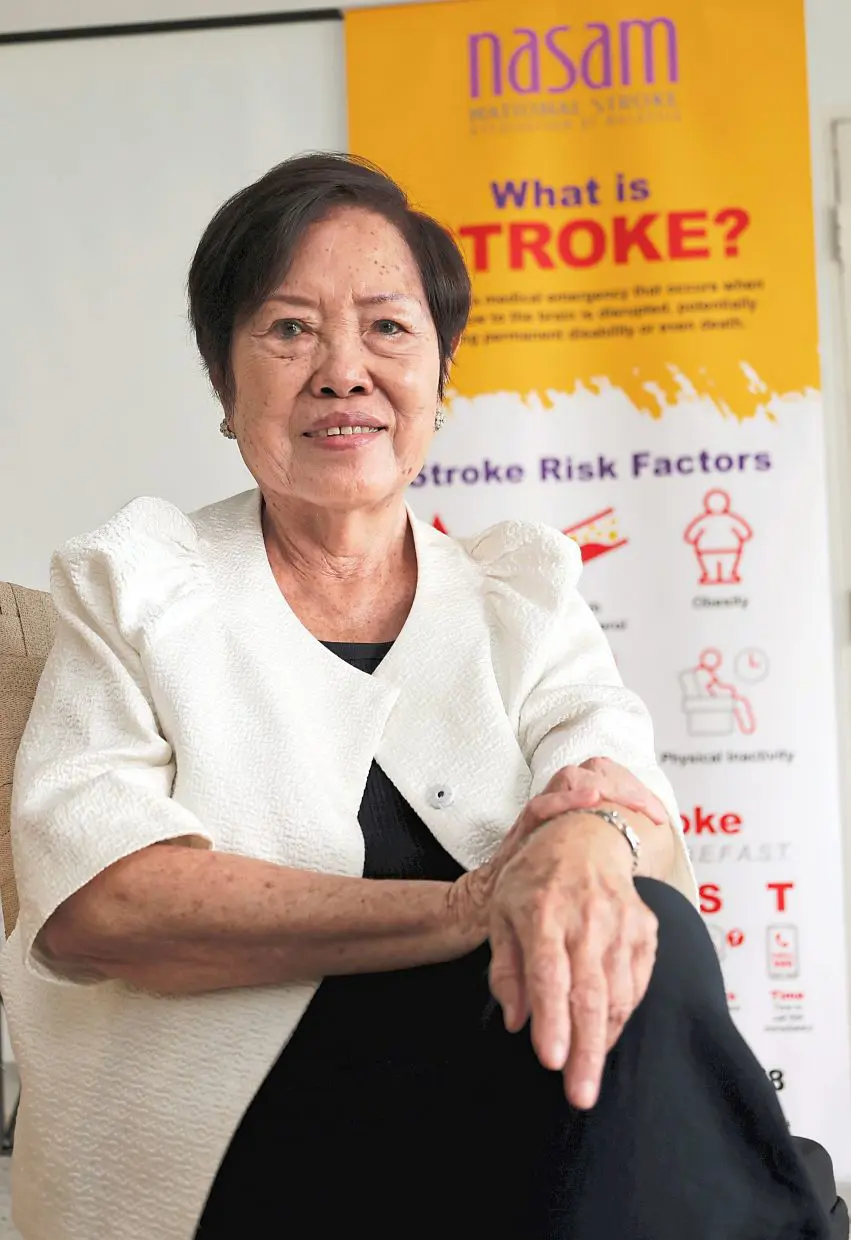
A group therapy session at Nasam’s first centre in Petaling Jaya, where stroke survivors exercise together in groups based on their functional levels, encouraging one another throughout their recovery.Starting from a stroke survivor support group, Yeo founded Nasam to help provide physiotherapy, as well as mental and emotional support, to these survivors.
Nearly four decades ago, Janet Yeo woke up and got ready for work as usual.
At 44, she was running two advertising businesses.
“I woke up one morning and then I had an evolving stroke.
“One of my hands couldn’t take commands.
“But at that moment, I could still walk and talk,” she shares.
Unaware that she was having a stroke, Yeo continued with her plans for the day, including an interview and a visit to the hairdresser before returning to her office.
“I didn’t realise that I was having a stroke because I didn’t know the signs and symptoms of a stroke,” she says.
But as the day progressed, her condition worsened.
Her right hand became immobile, and she eventually sought medical attention at a private hospital in Petaling Jaya, Selangor.
There, doctors told her she had suffered an ischaemic stroke.
This type of stroke occurs when a blood clot blocks blood flow to part of the brain.
Yeo spent the next month and a half in the hospital, eventually becoming completely paralysed on her right side and losing the ability to speak normally.
The will to recover
During that time, she fell into a deep depression.
“When I was in the hospital, I wanted to die; I was very depressed,” Yeo recalls.
In 1989, stroke rehabilitation in Malaysia was still relatively unfamiliar.
There was little information available to stroke survivors, and Yeo knew little about the condition herself.
“That year, there was no literature on stroke,” she says.
“There was no awareness of stroke – I didn’t know anything about stroke.”
Determined to learn more, she travelled to Singapore, where Mount Elizabeth Hospital had just established a stroke-specific rehabilitation unit.
What she saw there changed her understanding of stroke rehabilitation.
Rather than focusing solely on physical therapy, the programme taught stroke survivors how to manage everyday activities and regain their independence.
“They show you how to go to the bathroom.
“They teach you how to use two hands to brush your teeth,” she recalls.
Even mealtimes became part of rehabilitation, with simple adaptations such as wrapping a sponge around a spoon handle to make it easier to grip.
Yeo also learnt how early rehabilitation could help prevent complications such as foot drop.
At the hospital, staff would prop up the affected foot with a pillow.
“If the hospital doesn’t do that for you on the first day, you’ll have a drop foot, which I have,” she says.
Today, Yeo cannot lift her affected foot and has to wear a brace to help raise it.
Her rehabilitation journey continued beyond Singapore.
She spent another two months undergoing rehabilitation in the United States before travelling to Beijing to explore traditional Chinese medicine.
Despite still having difficulty speaking and walking, Yeo returned to work about a year after her stroke.
She went on to build four more businesses, while raising two children and caring for her mother, who had cancer.
“I lived my life,” she says.
But she knew she had been fortunate.
Her company provided health coverage, while insurance helped cover her rehabilitation.
She had access to physiotherapy, acupuncture, gym training and rehabilitation overseas – opportunities many stroke survivors do not have.
“Then I thought to myself, for someone without this access, how do they survive from a stroke?” she says.
A group therapy session at Nasam’s first centre in Petaling Jaya, where stroke survivors exercise together in groups based on their functional levels, encouraging one another throughout their recovery.
The idea of starting her own stroke support group was first voiced in a newspaper article.
A year after Yeo’s stroke, a journalist who had initially interviewed her contacted her again to see how far she had progressed.
That was when she expressed her desire to start a stroke support group.
A few years later, she began bringing stroke teams and survivors together at her office.
As the group grew, survivors asked her to provide physiotherapy.
The first rehabilitation space was not a hospital or a clinic; it was Yeo’s garage.
“We would take all the cars out and have the physio,” she recalls.
She hired a Malaysian physiotherapist, and the initiative operated from her office and home for four years.
It later moved next door, when her sister-in-law bought a house that was custom-built as a centre for the fledging organisation now officially registered as the National Stroke Association of Malaysia (Nasam).
It has now been operating there for 30 years.
But Yeo wanted Nasam to offer more than conventional rehabilitation.
She developed what she called a “holistic programme”, focusing not only on physical recovery, but also on the emotional and social needs of stroke survivors.
“If you go to a hospital, they treat you just like an arm and a leg.
“One hour, finish, bye-bye. See you next week,” she says.
“But here, we look at it from head to toe, because you are still the same person.
“You are still a mother, a father. You still have children. You’re still holistic.”
For Yeo, stroke recovery was also a mental journey.
She says survivors can experience shock and denial before potentially falling into depression.
Without adequate support, some survivors can become withdrawn or depressed.
“Once they are in depression, it’s very hard to get them out.”
Yeo also saw how financial circumstances could affect access to rehabilitation.
“A lot of poorer people don’t have insurance and can’t get physiotherapy.
“They go into depression and just accept it.”
At Nasam, the approach extends beyond therapy, with walks, outings, games and karaoke sessions designed to keep survivors engaged.
“If they don’t come to us, they stay in their room – four walls, TV screen – they give up.”
At the heart of it was a belief she wants every stroke survivor to hold on to: “There is life after stroke.”
Keeping Nasam going has brought its own challenges
One of Yeo’s biggest struggles has been finding and retaining qualified physiotherapists.
When she started the non-governmental organisation, many physiotherapists in Malaysia were foreign-trained and too expensive for her to hire.
Unable to compete with private sector salaries, Janet travelled to Mumbai, India, to recruit five physiotherapists.
“There were 30 people lined up to be interviewed, so I selected five,” she says.
As more hospitals established stroke rehabilitation units, competition for experienced physiotherapists increased.
“My biggest problem is to get good-quality physios who will stay and work for the small pay that I get, because I cannot compete with hospitals,” she says.
Some physiotherapists eventually leave to provide private home-based treatment, taking some stroke survivors with them.
“So we lose our physios, we lose some of our ‘strokees’, but we have to carry on.
“We’re very lucky that people who stay today, they are with us because they have love and passion,” she says.
For Yeo, the reward is seeing stroke survivors regain their independence.
“Satisfaction is when you see someone come in with a wheelchair or using a stick, but after a few months, they can walk out by themselves.”
Expanding the reach
Nasam was Malaysia’s first stroke-specific organisation, and today, operates six centres in Petaling Jaya, Ampang, Ipoh, Johor Bahru, Kuantan and Kota Kinabalu.
Yeo hopes to expand Nasam’s reach to more areas, as stroke survivors have requested centres closer to their homes.
As the organisation marks its 30th anniversary on Sept 5 (2026), it will bring stroke survivors together for an evening of singing, dancing and celebration.
Yeo, who is scheduled to undergo leg surgery before the anniversary, is looking forward to joining them.
“I want to dance during the anniversary and enjoy with the ‘strokees’,” she says with a laugh.
For more information on how to support Nasam, clickhere.
Policy choices: People cross Pennsylvania avenue in Washington. the federal government’s iou has now more than doubled in less than a decade, from us$19.95 trillion when trump was sworn in for the first time in January 2017.
WASHINGTON: Total US debt has topped US$40 trillion for the first time, the Treasury Department says on Wednesday, drawing fresh warnings that a fiscal crisis is brewing as ballooning costs for social safety-net programmes and interest payments far outstrip revenues held back by tax cuts.
The Treasury’s latest daily cash and debt balances statement showed total public debt outstanding at US$40.047 trillion on Tuesday, a total that includes Treasury securities held by the public of US$32.266 trillion and intra-governmental debt holdings of US$7.782 trillion.
The federal government’s IOU has now more than doubled in less than a decade, from US$19.95 trillion when President Donald Trump was sworn in for the first time in January 2017.
Roughly one-third of that increase occurred during two years of frantic government borrowing to fund the Covid-19 pandemic responses undertaken by Trump and former President Joe Biden, while the fiscal policy choices of both presidents combined with long-running tax-andspending imbalances to account for the rest.
Budget watchdog groups have been anticipating the crossing of the threshold for weeks and have issued stark warnings that a full-blown debt crisis could erupt unless lawmakers confront an unsustainable fiscal outlook and raise taxes, cut spending or both.
“Forty trillion dollars of debt doesn’t exist solely on the government’s ledgers, it is felt throughout the economy and finds its way to the pocketbooks of people one way or another,” said Maya Macguineas, president of the nonpartisan Committee for a Responsible Federal Budget.
“The more we borrow, the more we exacerbate inflation, squeeze out other priorities in the budget, and leave ourselves vulnerable to emergencies at home and turmoil abroad,” Macguineas said in a statement just after the Treasury data was released.
She noted that the US$40 trillion figure was reached less than five months after debt reached US$39 trillion, and has quadrupled in less than 20 years after taking until 1981 to reach US$1 trillion for the first time.
“It is staggering how predictable the fiscal decline of a global power can become,” Macguineas added.
Global US creditors may already be growing wary. Days after a Us$25bil auction of 30-year Treasury bonds went off at the highest yield since 2021, yields on so-called long bonds on Tuesday hit their highest levels in nearly two decades as investors demanded greater compensation in the face of hefty US government bond issuance.
On Wednesday, US Treasury Secretary Scott Bessent took a bold step to push long bond yields back, announcing a doubling of buyback sizes for 10 to 30-year treasuries to at least Us$4bil per operation.
The term premium for 10-year treasuries – a measure of how much of the security’s overall yield is accounted for by the perceived isk of holding them over a decade – rose this week to its highest in more than a dozen years.
Against all that, demand for US debt by foreign investors, who hold nearly onethird of all treasuries, has been declining over the past year, leaving more bonds to fall to more price-sensitive buyers, which can exacerbate market volatility, John Canavan, lead financial market analyst in Oxford Economics’ Macroeconomic and Investor Services group, wrote on Tuesday.
The Treasury last week reported the fourth-highest monthly deficit in US history, Us$432bil for July, as tariff refunds turned customs receipts negative for the third month in a row and outlays for Social Security and Medicare benefits for seniors continued to grow.
The deficit for the first 10 months of fiscal 2026 has already exceeded the total gap for all of fiscal 2025 with two months to go in the current fiscal year.
Trump has largely ignored the dwindling number of fiscal hawks in his Republican Party, championing heavy spending across his two terms.
Public debt rose by US$7.8 trillion during Trump’s first term, with more than half of it accumulating during the pandemic response over his last nine months in office.
Since Trump took office a second time in January 2025, the US debt load has increased by US$3.8 trillion, for total growth of US$11.6 trillion across his two terms so far.
Public debt increased by US$8.4 trillion during Biden’s term, also marked by heavy Covid-19 recovery spending, but driven as well by big-ticket outlays for infrastructure investment, clean energy subsidies and other priorities championed by his Democratic Party.
The Committee for a Responsible Federal Budget estimated that the policy choices of Trump and Biden have increased the federal debt trajectory beyond what would have accumulated under the existing spending statutes when each took office.
For instance, Trump’s landmark second-term legislative package, the One Big Beautiful Bill Act, will add another US$4.7 trillion in debt, according to the Congressional Budget Office, the nonpartisan bookkeeper for federal lawmakers.
Trump has branded his second presidency as one focused on cost-cutting, marked by early federal agency job cuts ordered by the non-governmental Department of Government Efficiency. — Reuters

 FILE - John Ternus, Apple's V.P. of Hardware Engineering, discuss the latest development for the iPad Pro during an event to announce new products Tuesday Oct. 30, 2018, in the Brooklyn borough of New York. (AP Photo/Bebeto Matthews, File)