
src='https://pagead2.googlesyndication.com/pagead/js/adsbygoogle.js?client=ca-pub-2513966551258002'/> Rightways: perak Infolinks.com, 2618740 , RESELLER

Pages

Share This

Deepseek https://www.deepseek.com/./深度求索 DeepSeek | 深度求索 https://askaichat.app/chat
Showing posts with label perak. Show all posts

Monday, December 1, 2025

Coconut industry rebounds strongly


The Matag coconut all cut up and ready to drink from its shell.

An aerial view of a Matag coconut plantation in Bagan Datuk, Perak. — Photos: Bernama

COCONUT and Bagan Datuk are inseparable.

A visit to this district is said to be incomplete without tasting its famously sweet young coconut water – a natural product many claim is unlike anywhere else in the country.

For hundreds of years, coconut has been the community’s primary commodity crop.

Bagan Datuk once earned a place on the world map as one of the most important coconut producing regions from the late 19th to mid-20th century.

Built on the rich alluvial soils at the mouth of Sungai Perak and blessed with a humid tropical climate, the region is naturally suited for growing Cocos nucifera, the coconut palm.


These natural conditions produce coconuts with thicker flesh, which will have richer and creamier coconut milk.

Today, coconut remains Perak’s second most important agricultural commodity after rice, reported Bernama.

According to the latest data from the Perak Agriculture Department, Bagan Datuk contributed nearly 90% of Perak’s coconut production or about 12% of Malaysia’s total supply, making it the country’s third largest producer after Selangor and Johor.

Coconut cultivation is a way of life in Bagan Datuk, practised by almost every household.

From small home plots to commercial plantations, Perak folk are growing modern hybrid varieties such as the Malayan Tall and Matag.
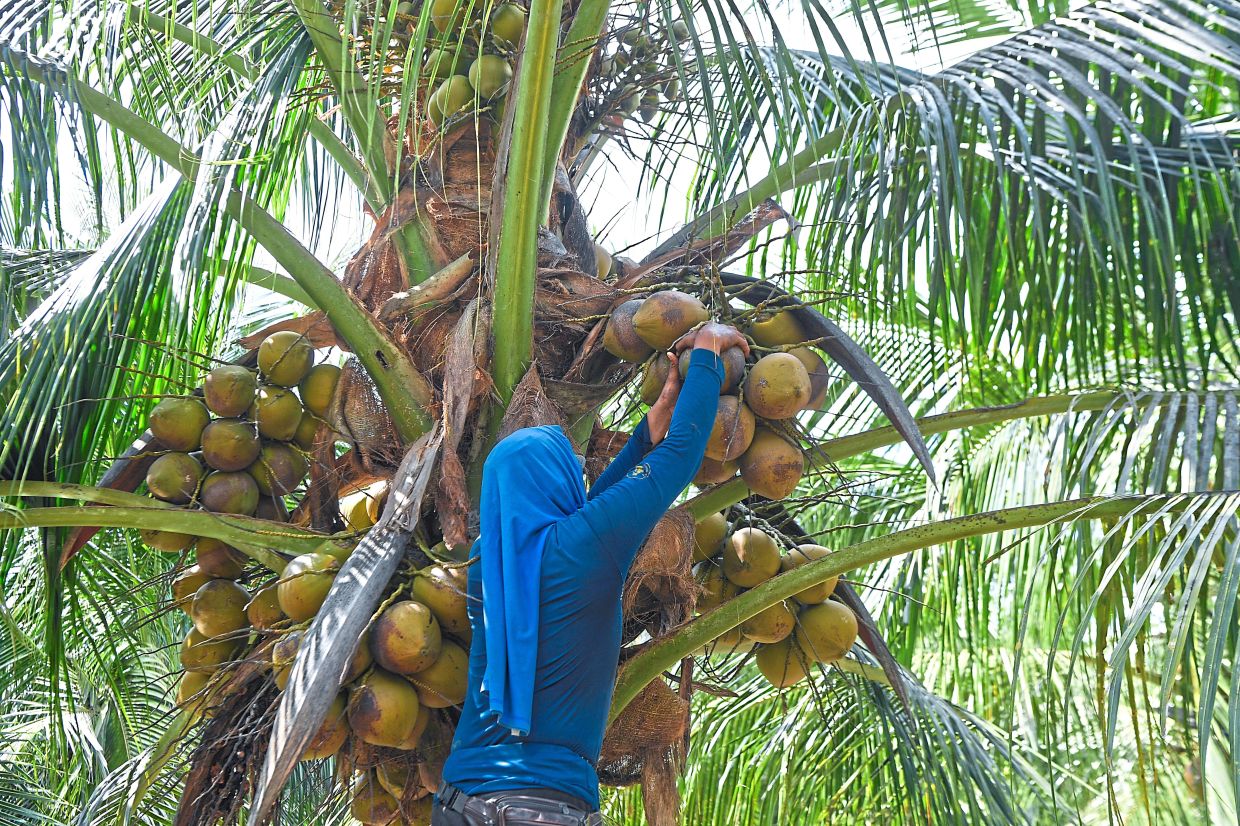
A worker plucking coconuts from a tree at the plantation in Bagan Datuk.A worker plucking coconuts from a tree at the plantation in Bagan Datuk.

Sweet coconut water

According to coconut grower and wholesaler Abdul Aziz Mokhtar, 50, the Matag variety is usually grown for both coconut water and coconut milk, while the taller Malayan Tall variety is more commonly cultivated for milk production.

“Some smallholders still plant the old varieties, what people call kelapa kampung or Malayan Tall and harvest a mix of old and young coconuts mainly for coconut milk,” he said.

Matag F1, he said, was relatively new to local farmers, introduced around five to six years ago by the Agriculture Department to improve yield and quality.

“Malayan Tall trees are known for longevity and stable yields, while Matag palms grow faster, produce more and stay shorter.”

“Matag trees can be planted more densely – about 70 trees per 0.4ha compared to 60 for Malayan Tall – because they are shorter and their fronds don’t spread as widely,” he added.

With more than 20 years experience in coconut farming, Abdul Aziz noted that research by the Agriculture Department and the Malaysian Agricultural Research and Development Institute (Mardi) has significantly improved coconut varieties.

“In the past, we only had the traditional local varieties, but over the past decade, new types like Pandan, Matag F1 and SGG have emerged,” he said.

The main advantage of the new types, he said, was speed.

“These new varieties mature faster – you can start harvesting in just three to three-and-a-half years.

“The older Malayan Tall or village varieties take seven to eight years to bear fruit, which is not commercially viable today,” he pointed out.

In August, Mardi announced the development of four new hybrid varieties, namely the Mylag, Marleca, Careca and Careni, which are capable of producing up to 25,000 coconuts per hectare annually.
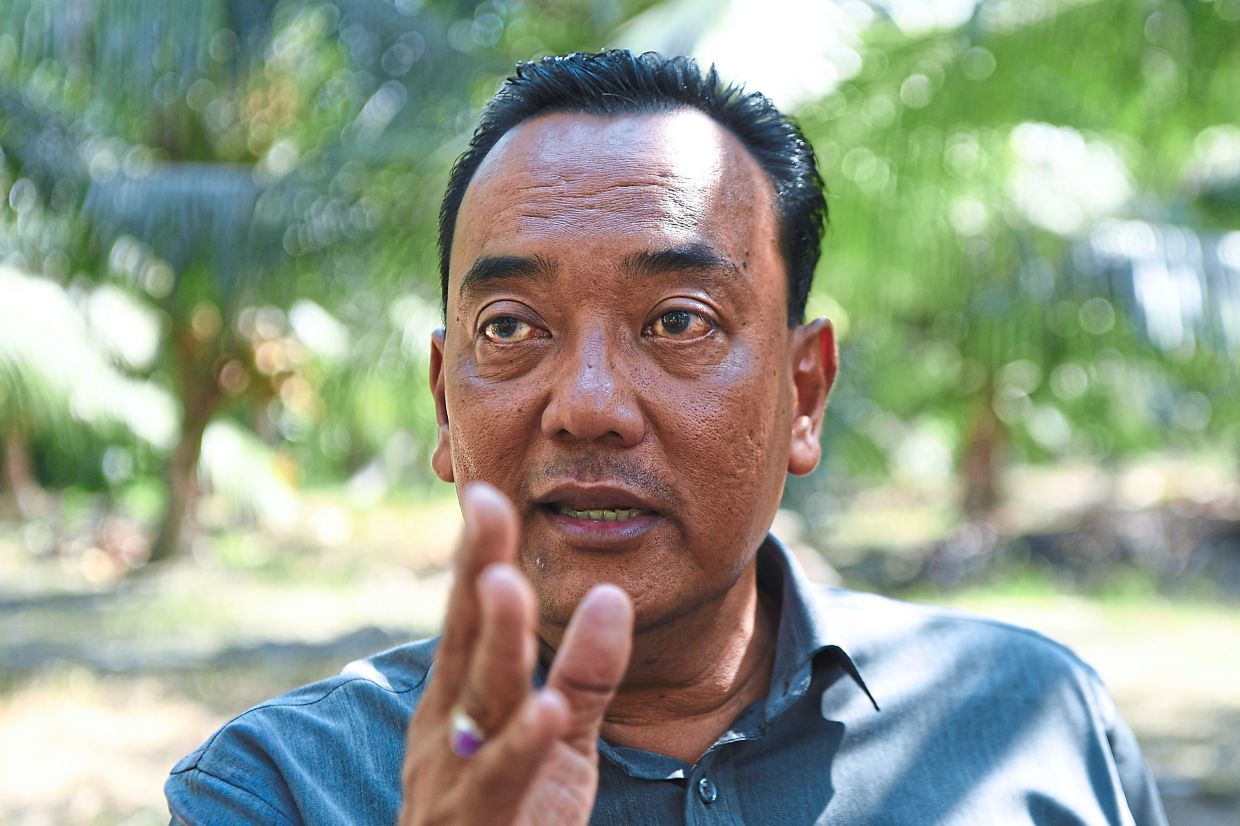
Abdul Aziz says the Matag F1 is a relatively new type to the local farmers.Abdul Aziz says the Matag F1 is a relatively new type to the local farmers.

Strong economic potential

A farmer’s income depends on the variety planted and the size of the farm, with some seeing returns as early as three to four years after planting.

On average, a grower tending two hectares can earn between RM2,000 and RM2,500 per month, based on an average price of RM1 per coconut.

Beyond selling fresh coconuts or coconut milk, many smallholders also produced value-added products such as kerisik and virgin coconut oil among other coconut-based goods.

Based on his experience engaging with foreign entrepreneurs at seminars and workshops, Abdul Aziz believes Malaysia has strong potential to become a coconut-exporting nation, but only if production stabilised.

“China is very interested in importing coconuts from Malaysia.
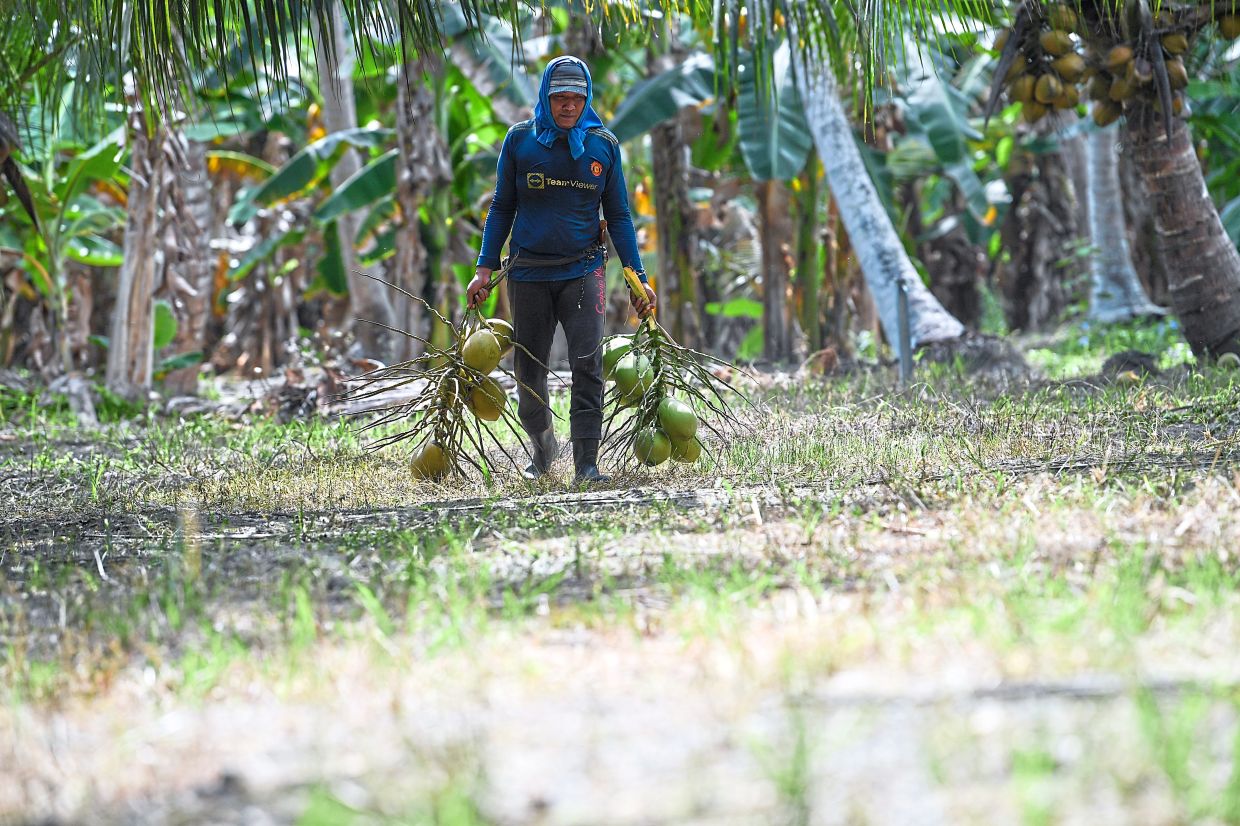
A coconut plantation worker in Bagan Datuk collected a bunch of Matag coconuts. - BernamaA coconut plantation worker in Bagan Datuk collected a bunch of Matag coconuts. - Bernama

“Inconsistent supply remains the biggest barrier.

“If they request one million coconuts and we cannot deliver, it becomes a major issue,” he said.

He believes that once production challenges are addressed, Bagan Datuk can become a major global supplier, bringing significant economic benefits to local communities.

Youths returning home

As urban job markets become increasingly uncertain, more young people are returning to their hometowns to pursue agriculture, including coconut farming which offers a stable income potential.

For young people with access to family land, even over a 1.2ha is enough to generate side income.

Properly maintained, every 0.4ha can yield about 800 young coconuts per month, bringing in around RM800.

It has now become a trend among the district’s youth – farming on their own, managing family plots or even helping relatives, despite having full-time jobs.

One of them is Syamsul Bahri Imam, 38, who previously worked in building maintenance. He returned to his village to continue his late father’s coconut farming legacy.

“I took over when my father fell ill, and continued the work after he passed away.

“People used to think coconut farming was an old man’s job, but now many young people are interested. Some are continuing their fathers’ work, others are starting from scratch,” he said.

Syamsul said city life was expensive and that earning RM3,000 in the city may not be enough, but RM2,500 in the village was comfortable.

“You have your own home, food is cheaper and government support like fertiliser and pesticide subsidies help a lot.”

Still, he notes that challenges remain, such as pests especially monkeys, which frequently target coconut farms.

Government commitment

Perak Agriculture Department director Norsiyenti Othman said both the state and Federal governments have channelled targeted allocations through programmes such as the New Planting Programme and Rehabilitation Programme to support coconut farmers.

“To strengthen the direction of the coconut industry, the Perak Agriculture Department received RM1.26mil in allocations from the state and Federal governments,” she said.

The funds covered agricultural development, training and small-scale agro-based industry (IAT) programmes, she added.

Bagan Datuk district remains the state’s leading producer with 80,029 tonnes followed by Manjung (4,192 tonnes) and Kinta (1,718 tonnes).

The state’s coconut industry continues to grow, achieving a Self-Sufficiency Level (SSL) of 141%.

Norsiyenti said output increased to 89, 978 tonnes across 7,478ha in 2024, driven by replanting and rehabilitation efforts.

Under Perak’s coconut development initiative, two main sub-programmes are implemented.

One of it is new planting and replanting incentives that include land clearing, removing old trees, site preparation, hole-digging, fencing and installation of irrigation and drainage systems.

Farmers also receive inputs such as fertilisers, pesticides, tools and certified seedlings.

The second one is rehabilitation of existing farms, where participants receive similar agricultural inputs to restore productivity on older farms.

In 2024, a total of 61.01ha were covered under both programmes, benefitting 40 recipients who collectively produced 420 tonnes of coconuts worth RM546,000.

Tuesday, November 18, 2025

Childcare centres on the decline: Childcare centres closing in KL, Putrajaya and Perak despite rising demand


Demand up but operators struggle with high costs, red tape, staff shortage

PETALING JAYA: The number of registered childcare centres in Kuala Lumpur, Putrajaya and Perak fell last year despite growing demand, as operators struggle with rising costs, staffing woes and red tape.

Figures from the Department of Statistics Malaysia show an 11% drop in Kuala Lumpur in 2024 compared to the year before, from 218 to 193.

Putrajaya and Perak both declined by 21%, with Putrajaya falling from 62 to 49, while Perak dropped from 245 to 194.

Despite fewer childcare centres in these three locations, enrolment grew by 8% in Kuala Lumpur, 10% in Putrajaya, and 33% in Perak, reflecting rising demand.

Negri Sembilan, Penang, Sabah, Melaka and Labuan also saw a drop in the number of childcare centres, but enrolment also fell in these places.

Made with Flourish • Create a data story

Nationwide, the total number of registered childcare centres rose by 1.3% to 3,198 in 2024, according to DOSM’s Children’s Statistics Malaysia 2025 report.

There are currently 2.3 million children aged four and below in Malaysia, and industry players estimate that the country needs at least 40,000 to 50,000 childcare centres.

Made with Flourish • Create a chart

Registered Childcare and Development Association of Malaysia president Norsheila Abdullah said the past few years saw about 10% of registered child centres in Kuala Lumpur, Putrajaya and Perak shutting down.

She said the trend of closures signals increasing strain faced by operators.

Many are barely able to cope with steep hikes in rent, utility and food prices, as well as stricter safety and health compliance standards.

These factors have made it difficult especially for smaller centres to remain financially sustainable.

Norsheila said many community or workplace-based centres are outsourced to private operators, who must pay high rents imposed by departments and ministries.

“This places a huge burden on private operators, who are expected to charge low monthly fees while meeting minimum wage requirements for childcare providers,” she said.

Norsheila said strict licensing and safety regulations under the Social Welfare Department (JKM) are important, but noted that smaller centres are struggling with the administrative burden and cost of compliance.

She said streamlining state and federal regulations and introducing shared inspection systems could help maintain quality without overwhelming operators.

She warned that the widening gap between childcare demand and available supply may drive up fees.

This could limit access for middle and lower-income families, pushing some parents toward informal or unregistered childcare options that lack proper safety standards.

Norsheila called for stronger collaboration between state and federal governments to encourage the setting up of community-based and workplace childcare centres, supported by tax reliefs, rental subsidies and the use of underutilised public buildings.

She also proposed introducing minimum wage standards for childcare educators, tied to their qualifications.

In addition, she suggested expanding training through TVET institutions and universities, and scaling up fee assistance or childcare voucher schemes for B40 and M40 families.

Norsheila said digital and administrative reforms, such as an integrated childcare database and a simplified online licensing system under JKM, could further ease operations.

Siti Ruzita Ramli, who heads the Selangor and Federal Territory chapter of Persatuan Tadika Islam, said operational costs and a shortage of qualified educators are straining childcare centre operators.

“Currently many centres struggle to maintain quality while managing higher expenses for rent, increments of the salary which is now at RM,1800, food, and learning materials,” she added.

Siti Ruzita said it has become increasingly difficult to retain passionate teachers due to heavy workloads and low pay.

“Universities can play a role by providing work and learn opportunities based on the ‘place and train’ concept, helping to reduce the high wage burden for employees,” she said.

Penang Preschool Teachers Association president Sally Ng Chit Peng said rising living costs have worsened the situation for childcare operators in the state.

“The cost of living in Penang has increased significantly, with higher expenses for rent, utilities, food, and wages,” she said.

Ng said the shortage of caregivers also remains a major concern, as low salaries and limited career progression make it difficult to attract and retain staff.

She also called for greater flexibility in licensing to help operators manage costs.

“Allow one building to operate both a childcare centre (taska) and a preschool (tadika) under dual licences.

“A dual licence setup saves space, reduces operating costs,” she said.

Ng noted that, under current regulations, the two must operate separately.

PETALING JAYA: The number of registered childcare centres in Kuala Lumpur, Perak and Putrajaya fell last year despite growing demand, as operators struggle with rising costs, staffing woes and red tape.

Figures from the Statistics Department (DOSM) showed an 11% drop in Kuala Lumpur in 2024 compared with the year before, from 218 to 193 centres.

Putrajaya and Perak both declined by 21%, with Putrajaya falling from 62 to 49 centres, while Perak dropped from 245 to 194 centres.

Despite fewer childcare centres in these three locations, enrolment grew by 8% in Kuala Lumpur, 10% in Putrajaya and 33% in Perak, reflecting rising demand.

Labuan, Melaka, Negri Sembilan, Penang and Sabah also saw a drop in the number of childcare centres, but enrolment also fell in these places.

Nationwide, the total number of registered childcare centres rose by 1.3% to 3,198 in 2024, according to DOSM’S Children’s Statistics Malaysia 2025 report.

There are currently 2.3 million children aged four and below in Malaysia, and industry players estimate that the country needs at least 40,000 to 50,000 childcare centres.

Registered Childcare and Development Association of Malaysia president Norsheila Abdullah said the past few years saw about a 10% drop of registered child centres in Kuala Lumpur, Perak and Putrajaya.

She said the trend of closures signals increasing strain faced by operators.

Many are barely able to cope with steep hikes in rent, utility and food prices, as well as stricter safety and health compliance standards.

These factors have made it difficult, especially for smaller centres, to remain financially sustainable.

Norsheila said many community or workplace-based centres are outsourced to private operators, who must pay high rents imposed by departments and ministries.

“This places a huge burden on private operators, who are expected to charge low monthly fees while meeting minimum wage requirements for childcare providers,” she said.

Norsheila said strict licensing and safety regulations under the Social Welfare Department (JKM) are important, but noted that smaller centres are struggling with the administrative burden and cost of compliance.

Streamlining state and federal regulations and introducing shared inspection systems could help maintain quality without overwhelming operators, she said.

She warned that the widening gap between childcare demand and available supply may drive up fees.

This could limit access for middle and lower-income families, pushing some parents towards informal or unregistered options that lack proper safety standards.

Norsheila called for stronger collaboration between state and federal governments to encourage the setting up of community-based and workplace childcare centres, supported by tax reliefs, rental subsidies and the use of underutilised public buildings.

She also proposed introducing minimum wage standards for childcare educators, tied to their qualifications.

In addition, she suggested expanding training through TVET (technical and vocational education and training) institutions and universities and scaling up fee assistance or childcare voucher schemes for B40 (lower income) and M40 (middle income) families.

Norsheila said digital and administrative reforms, such as an integrated childcare database and a simplified online licensing system under JKM, could further ease operations.

Siti Ruzita Ramli, who heads the Selangor and Federal Territory chapter of Persatuan Tadika Islam, said operational costs and a shortage of qualified educators are straining childcare centre operators.

“Currently, many centres struggle to maintain quality while managing higher expenses for rent, salaries, food and learning materials,” she added.

Siti Ruzita said it has become increasingly difficult to retain passionate teachers due to heavy workloads and low pay.

“Universities can play a role by providing work-and-learn opportunities based on the ‘place and train’ concept, helping to reduce the high wage burden for employees,” she said.

Penang Preschool Teachers Association president Sally Ng Chit Peng said rising living costs have worsened the situation for childcare operators in the state.

“The cost of living in Penang has increased significantly, with higher expenses for rent, utilities, food, and wages,” she said.

Ng said the shortage of caregivers also remains a major concern, as low salaries and limited career progression make it difficult to attract and retain staff.

She called for greater flexibility in licensing to help operators manage costs.

Under current regulations, childcare centres (taska) and preschools (tadika) must operate separately, Ng noted.

“Allow one building to operate both as a childcare centre and a preschool under dual licences.

“A dual licence setup saves space and reduces operating costs,” she said.

 PETALING JAYA: Urban parents want safe, high-quality childcare, but rising costs and limited options are forcing tough choices.

Saturday, November 7, 2020

CMCO announced in 6 more states: Kedah, Penang, Perak, Melaka, Johor and Terengganu


Senior Minister for Security Ismail Sabri Yaakob said only Perlis, Pahang and Kelantan are exempted from the CMCO

New Covid-19 cases at its highest 


PETALING JAYA: The government has announced a month-long conditional movement control order (CMCO) in Kedah, Penang, Perak, Melaka, Johor and Terengganu from Monday due to the rising number of Covid-19 cases in the states.

The CMCO will end on Dec 6.

“It will be for all states in Peninsular Malaysia, except for Perlis, Pahang and Kelantan,” said Senior Minister for Security Ismail Sabri Yaakob at a press conference today.

“The implementation of the CMCO is to allow the health ministry to conduct targeted screenings and to decrease movement in the community, in addition to curbing the spread of Covid-19 in these states.”

The rules under the CMCO are as follows:

  • inter-state and inter-district travel is prohibited, except for emergency cases, in which case a travel permit by the police is required and all workers must either show their employee pass or a letter from their companies;
  • only two members of a household may leave the house to buy necessities;
  •  all schools, higher education institutions, training institutes, kindergartens, childcare centres, public parks and recreational centres will be closed;
  • activities in the economic, industrial and trade sectors would be allowed to operate as usual;

  •  all forms of public transport, such as buses, taxis and e-hailing services, with a maximum of two passengers, are allowed to operate from 6am to midnight;

  • daily markets are allowed to open from 6am to 2pm, while wholesale markets may operate from 4am to 2pm, and night markets from 4pm to 10pm;

  • petrol stations may operate from 6am to 10pm but those located along highways may operate 24 hours;

  • clinics and public hospitals will be allowed to open for 24 hours while pharmacies and medicine stores may operate from 8am to 11pm;

  • fishing, farming and the agriculture sectors may operate as usual; and;

  • all social gatherings, including weddings, and entertainment activities, are not allowed.

大马政府宣布CMCO州属最新作业标准程序(SOP)!这个很重要!一定要让家人朋友知道啊!

http://beetify.com/article/1604826376

SOP_PKPB_Semenanjung_Malaysia_kecuali_Perlis,_Pahang_dan_Kelantan.pdf

 Ismail also said all religious activities in mosques will be decided by the state religious authorities, adding that further details may be found on the National Security Council’s (MKN) website.

Meanwhile, Ismail announced that the Maahad Al-Yahyawiah government-aided religious school in Padang Rengas, Kuala Kangsar, Perak, will be placed under the enhanced MCO from tomorrow until Nov 21.

He said the decision was made after 27 positive cases were detected in the area on Nov 5.

He added that the health ministry would continue conducting targeted screenings on a total of 123 students and 11 staff members at the school.

 CLICK HERE FOR THE LATEST DATA ON THE COVID-19 SITUATION IN MALAYSIA


Source link


Related post:


What Is PCR Testing for COVID-19?

Tuesday, July 18, 2017

Deadly Rabies in Dogs Alert !


Quarantine declared in ‘rabies area’


The war against rabies is on with the Matang sub-district declaring it a “rabies infected area” effective yesterday, following the death of a rabid dog which bit two girls in Kuala Sepetang.

Calling it an immediate measure to curb the spread of rabies, Perak Mentri Besar Datuk Seri Dr Zambry Abd Kadir signed the declaration, which bars people from bringing dogs out of the zone.

If they want to do so, they will need written permission from the state Veterinary Services Depart­ment director.

Announcing the decision to the press yesterday, Dr Zambry said the area would be monitored by the Perak Veterinary Department.

A special task force headed by Perak Health Committee chairman Datuk Dr Mah Hang Soon was also formed.

“Those with pet dogs will have to watch them closely and keep them in enclosed areas.

“The Veterinary Department has hired qualified personnel to deal with rabid dogs. Dogs found having symptoms of rabies will be culled,” Dr Zambry said.

The authorities had begun vaccinating all pets within a 1km radius of Kuala Sepetang, about 70km from here, on Sunday.

Veterinary Services director-general Datuk Dr Quaza Nizamuddin Hassan Nizam said the two-year-old rabid dog bit its owner’s 11-year-old daughter and 12-year-old niece at a house in Tepi Sungai at about 7pm on July 4.

The dog is believed to have been bitten by another dog brought into the country on a boat by foreigners.

Dr Zambry said that although no other cases had been reported, the quarantine was put in place as a precaution.

“This restriction only involves animals. Humans can move freely in and out of the area,” he added.

At a separate press conference in Kuala Sepetang, assemblyman Chua Yee Ling said the focus would be on monitoring the movement of dogs, vaccinating pet dogs and taking samples from strays.

Meanwhile, the mother of one of the two girls bitten by the pet dog was unhappy that she was not told that the dead dog had tested positive for rabies.

The 40-year-old hawker, who only wanted to be known as Ooi, said she found out about it from friends who came to her house.

She said the two girls had recovered and returned to school.

“I hope the public will respect my privacy and let me focus on looking after the girls,” she said.

She said both girls would receive four more vaccine jabs at Taiping Hospital in the next two weeks.

Residents in the fishing village seemed calm, although many remained jumpy at the sight of stray dogs.

Veterinary Services Department officers were spotted going door to door to inform the villagers about rabies and enquire about pet dogs.

Sources: The Star  by T. Avineshwaran Amanda Yeap


Related Links:

Infectious diseases making comeback - Nation | The Star Online

Five-year-old girl succumbs to rabies in Sarawak

19 strays culled in location of rabid dog attack

Penang on high alert, to set up a ‘buffer zone’

Perak declares Matang sub-district a rabies infection area

Fisherman: At least 60 strays died mysteriously  

Plan to quarantine several areas in Sarawak to contain rabies
 
Rabies in Dogs: Vaccination, Symptoms, Diagnosis, and Treatment


Related posts:

No dog until neighbours agree 


Dog attacks humans, it’s the owner, not the breed! 


How to avoid dogs attack you? 


Pit bull Terrier, a restricted breed; Time to regulate pet shops! 


Beauty and the beast in sports 


Biting demand over dog attack; keep stray dogs off the street!